logo

WordPress Design Agency

020 3355 8747

Message Us
  • Home
  • About Impact®
    Learn More About Impact Media®
    • Meet The Team
       
    • Why WordPress
       
    • Careers
       
    • Giving Back
       
    • 100K Tree Challenge
       
    James Coates
    Schedule a discovery call with UX Specialist James
    Book A Call
  • WordPress Services
    Learn More About Our Services
    • WordPress Web Design
       
    • UX Design
       
    • WordPress Development
       
    • WordPress Support & Maintenance
       
    • WordPress Evolve Retainer
       
    • WordPress Multisite Development
       
    • WooCommerce
       
    • Replatform To WordPress
       
    • WordPress Consultancy
       
    • Integrations & Plugins
       
    • WordPress Managed Hosting
       
    • WordPress Health Check
       
    James Coates
    Schedule a discovery call with UX Specialist James
    Book A Call
  • Our Process
  • Case Studies
  • Insights
  • Contact Us
WordPress Design Agency
020 3355 8747
logo logo
Book A Call
Back
Menu
  • Home
     
  •  
    About Impact Media
    Learn More About The Impacters
    • Meet The Team
       
    • Why WordPress
       
    • Careers
       
    • Giving Back
       
    • 100K Tree Challenge
       
  •  
    Our Services
    Discover How We Can Help
    • WordPress Web Design
       
    • UX Design
       
    • WordPress Development
       
    • WordPress Support & Maintenance
       
    • WordPress Evolve Retainer
       
    • WordPress Multisite Development
       
    • WooCommerce
       
    • Replatform To WordPress
       
    • WordPress Consultancy
       
    • Integrations & Plugins
       
    • WordPress Managed Hosting
       
    • WordPress Health Check
       
  • Our Process
     
  • Case Studies
     
  • Insights
     
  • Contact Us
     
020 3355 8747
Mon - Fri • 9am - 5pm
Close

Oops! We could not locate your form.

Home / Insights / Creating A Better Internet With More Sustainable Websites
Back

Creating A Better Internet With More Sustainable Websites

Published 26.02.25
26th February 2025
Last Updated 14.08.26
14th August 2026

Newer
10 Min Read
Crystal Coates
Crystal Coates
Web Design
Older
10 Min Read
 
Crystal Coates
Crystal Coates
 
Web Design

Learn the importance of building more sustainable websites, for reducing carbon emissions and promoting environmental responsibility in the digital space.

The behemoth that is the internet may feel intangible to most us, as we’re disconnected from the massive infrastructure that underpins it.

IT Crowd TV show scene referencing 'the internet' as a physical box

However, its environmental impact is very real. Websites, data centres, and online services consume vast amounts of electricity and water, contributing significantly to global carbon emissions. 

It is regularly said that if the internet were a country, it would be one of the most polluting nations on the planet.

This is only set to increase, especially with the explosive growth of generative AI, which is very resource hungry (in both training and use). The International Energy Agency projects global data centre electricity consumption will rise from around 415 TWh in 2024, to roughly 945 TWh by 2030, driven largely by AI workloads.

A recent UN University report put last year’s global data centre electricity use at around 448 TWh, linked to roughly 208 million tonnes of CO2 emissions, comparable to Argentina’s annual output, and around 1.2 trillion gallons of water consumed in generating that power.

So how as businesses, do we reduce our footprint in the digital space, as we also endeavour to do so in the offline environment?

Digital Sustainability

As businesses try to reduce their environmental impact offline, through sustainability initiatives, it is important to also embrace digital sustainability.

Digital sustainability refers to the practice of designing, developing, and managing digital technologies in an environmentally and socially responsible way.

It involves reducing the carbon footprint of digital activities, ensuring ethical and inclusive technology use, and creating long-lasting, adaptable digital solutions.

Some simple ways in which we can reduce our overall digital impact as individuals and businesses include:

Energy Supply – Choose an electricity supplier that uses 100% renewable energy.

Emails – Consider if you need to send that email, and does it really need to be a ‘reply all’. Remove all of the attachments and conversation history if they are not needed when replying or forwarding an email. Keep your inbox, archive, bin and spam folders clean. Have regular clear outs of emails you don’t need to keep.

Browsing – Do you really need to keep your 100 emotional support browser tabs open all the time? Does your browser have performance improving settings you can use to nerf background activity?

AI Use – Be selective in how you use generative AI in your workflow. Do you really need it to write that email for you? Is that search riddled with confidently incorrect information in the overview really necessary? Is anyone going to actually read that boring blog post you had it write?

Deleting Stored Files – If you use cloud storage like Google Drive, or Microsoft OneDrive, ensure you delete old files that you no longer need. Delete all of those blurry work Christmas party photos, or the 7 earlier versions of that document you created 8 years ago.

Websites & Hosting – Yes, this is the one we’re about to talk about in more length.

Why Does Web Sustainability Matter?

Every website visit requires electricity, whether it’s to load a webpage, send an email, stream a video, or process an online transaction. This electricity powers data centres, networks, and user devices, much of which still comes from fossil fuels.

This doesn’t even take into account the water used. Data centres consumed enough water last year to fill roughly 1.8 million Olympic sized swimming pools. By 2030 their water footprint is projected to equal the basic annual water needs of all 1.3 billion people in Sub-Saharan Africa.

With rising energy demands, web designers and developers must rethink how we build digital products to align with climate goals.

What Is Sustainable Web Design & Development?

Sustainable web design and development is about reducing the carbon footprint of digital products while improving efficiency and user experience. By optimising websites for sustainability, we not only minimise environmental harm but also create faster, more accessible, and cost-effective digital experiences.

A single large high-traffic website can generate hundreds of kilograms of CO₂ per year if inefficiently designed.

If you want a quick sense of where your own website stands, free tools like Ecograder will give you a rough estimate in seconds. For a full audit that goes beyond surface level, check out our WordPress Health Check that covers sustainability as one of its 8 pillars.

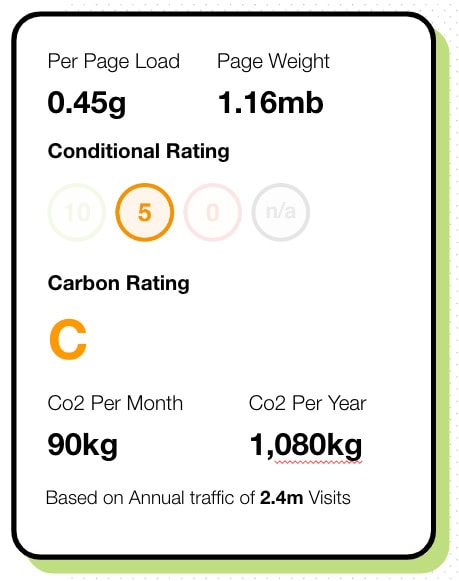
Here is an example of just the homepage of a site we carried out a Health Check for:

website homepage carbon from a website we audited

As a web design agency, it is our duty to consider our own impact, but also how we can reduce the impact created by the websites we design and build for our clients. 

The Key Principles Of Building Sustainable Websites

Consider Energy Efficiency

This one is pretty straightforward as a concept: less data transfer = less energy consumption.

But website design these days often favours big bold images, auto-playing videos, interactive animations, and other things that can be anathema to energy efficiency.

Whilst brands may want flashy, interactive and engaging websites, it is important to strike a balance. By reducing the size and complexity of web pages directly lowers electricity use. 

Some simple yet powerful steps that we use to achieve this, include:

Compress Images And Videos

Images and videos are often the weightiest elements on a website, demanding more space and energy. Avoid uploading images that are larger than necessary, and compress your images, to reduce file sizes. 

We have a post on image compression here.

Lazy-Load Images 

When a user lands on a page, the area they see on their screen is what is called ‘above the fold’. Images above the fold should load immediately as they are what the user sees initially, but any images below the fold can use lazy-loading. This means that they don’t load until the user scrolls.

As anyone in marketing knows, a chunky percentage of users will not scroll all the way to the bottom of all the pages they visit, so if they don’t, lazy-loading means these images never need to load for them.

Embed Video

Videos are beasts and can severely hamper website performance and energy efficiency. They should be used selectively, and embed videos, rather than uploading them directly to your website.

Limit Autoplay Media And Animations

Not only are you doing the environment a solid, you’re also doing me a favour. I hate auto playing video and audio! 

Use Caching And CDNs

Making use of caching and CDNs (Content Delivery Networks) reduces repeat data loads

Use Efficient Coding Practices To Reduce Unnecessary Scripts

Clean well structured code loads faster and puts less strain on servers and devices. Avoid unnecessary third party scripts, remove unused CSS and JavaScript, and keep custom code lean, rather than relying on bloated page builder output.

Design for Performance and Speed

Faster websites aren’t just good for users, and your SEO performance, they’re better for the planet.

When websites load slowly, they require more server processing power and network activity. 

Some ways to improve performance include:


Use Lightweight Frameworks

We’re big proponents of this, building bespoke themes, with our own lightweight framework and Imblox page builder. 

We do not use bloated off-the-shelf themes, and we avoid the use of heavyweight page editors like Elementor, WP Bakery and Divi.

Keep Up With The Latest Version Of PHP

As PHP is iterated and improved, it becomes more efficient, requiring less resources. So make sure your website is compatible with the latest version of PHP, and on a server running the latest version.


Minimise HTTP Requests 

Reduce third-party scripts wherever you can. Do you really need to use all of those plugins, or those CRO tools?

  • Regularly review your plugin library and also delete deactivated plugins.
  • Review your tags if you use GTM, to clean out anything that isn’t required. 


Optimise Fonts

Custom fonts can add unnecessary weight, and depending on how they are implemented, they can impact load times and rendering performance. Limit the number of font weights and styles you load, and consider using system fonts where the design allows for it.

Good UX

A website that is easy to use, gets a user to their destination and goal quickly, visiting fewer pages and using less resources.

Consider:

  • Well signposted CTAs.
  • A user friendly navigation.
  • Properly planned user journeys.

Make Your Website Accessible And Inclusive

Accessibility and sustainability go hand in hand.

A sustainable website should be accessible to all users, including those with low-bandwidth connections, older devices, or disabilities.

  • Use clean HTML & semantic tags for better accessibility.
  • Ensure your site works well without JavaScript.
  • Reduce reliance on high-powered devices, as not everyone can afford the latest tech, or the fastest internet connection.

This ensures a wider audience can use your website with less environmental impact.

Prioritise Honest & Ethical Digital Practices

Websites often manipulate user behaviour with dark patterns. These are tricks that push users into unwanted subscriptions or excessive scrolling. This leads to unnecessary time spent online, increasing energy consumption.

  • Be transparent about your carbon footprint.
  • Minimize intrusive tracking and unnecessary ads.
  • Encourage responsible digital behaviour, such as offline modes or low-energy settings.

Choose Green Hosting & Local Data Centres

Where your website is hosted matters.

Green Hosting

Data centres consume vast amounts of electricity, but not all are created equal. Opting for a green web host means your site is powered by renewable energy sources such as solar, wind, or hydro.

We host our clients’ websites on servers powered by 100% renewable energy, and have done since before 2017. That includes our own website.

When choosing a host:

  • Check if they use 100% renewable energy.
  • Research their energy efficiency measures.

A simple hosting switch can drastically reduce your website’s carbon footprint.

Local Data Centres

Choose a data centre that is close to the bulk of your audience, to reduce the energy used transmitting that data.

So if you have a predominately UK audience, pick a UK data centre. If your audience is mostly in Canada, use a data centre there. If you have a global audience, choose a data centre where the highest percentage of your audience resides, and the CDN we mentioned previously will assist, by distributing and serving assets across global servers.

As digital professionals, we have a responsibility to build a cleaner, more efficient internet. Building sustainable websites doesn’t just reduce carbon emissions, it also creates better, faster, and more accessible websites that benefit everyone.

If you’d like some help reducing the impact of your WordPress website, our Evolve retainers can be used to improve the performance of your site, which in turn improves their efficiency.

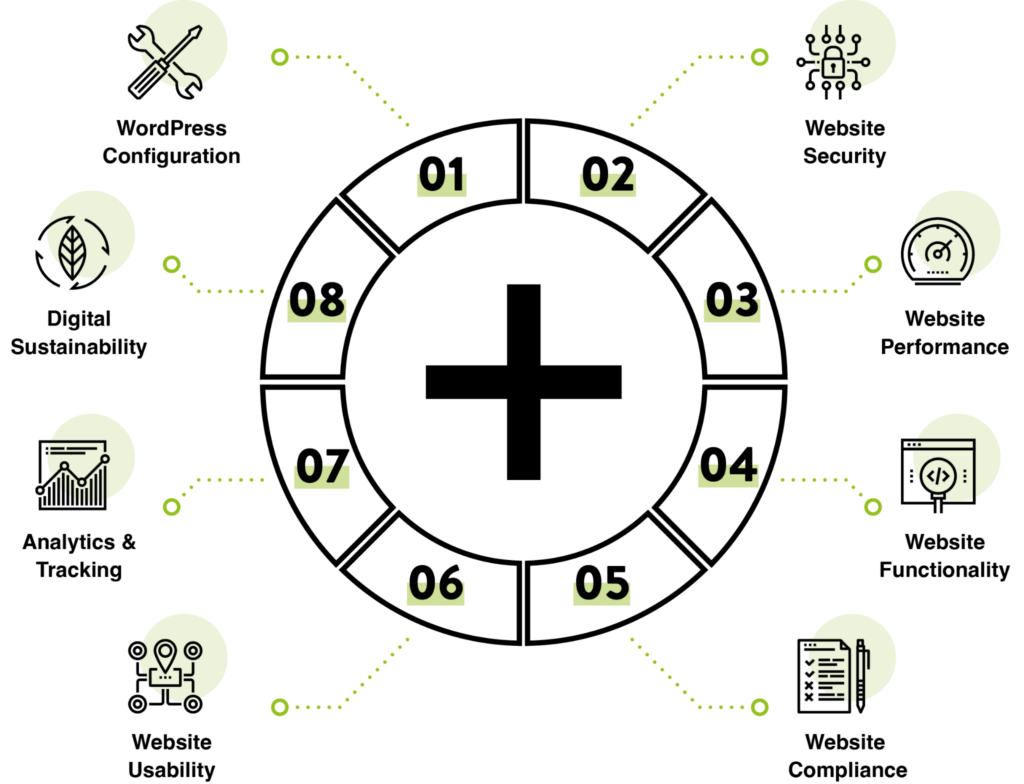
Alternatively, if you’d like to understand how sustainable your current website is, speak to us about a WordPress Health Check. Sustainability is one of the 8 pillars of the our Health Check audits.

the 8 pillars of our wordpress health check: configuration, sustainability, analytics & tracking, security, performance, functionality, and compliance.

Share Socially
Crystal Coates
Crystal Coates
Account Manager, Converse Enthusiast & Copacabana Dance Winner 1995
Crystal is an Account Manager and cares for our clients. She is usually the first point of contact for website support.
View Team Profile
See More Articles
Crystal Coates
Crystal Coates
Account Manager, Converse Enthusiast & Copacabana Dance Winner 1995
Crystal is an Account Manager and cares for our clients. She is usually the first point of contact for website support.
See More Articles
View Team Profile
Want more control over
how you manage content in WordPress?
Edit content that was previously restricted and get creative with building pages in WordPress.
Let's Chat
studio@impactmedia.co.uk
020 3355 8747
Impact Media's LinkedIn
Impact Media's Twitter
Impact Media's Facebook
Impact Media's Instagram
Impact Media's Youtube
wordpress.org

About Impact

  • About Impact Media®
  • Meet The Impact Team
  • Why WordPress?
  • Our Web Development Process
  • Careers
  • Awards
  • Partners
  • Giving Back
  • 100K Tree Challenge

WordPress Services

  • WordPress Web Design
  • UX Design
  • WordPress Development
  • WordPress Evolve Retainers
  • WooCommerce Development
  • Multisite WordPress
  • Migrate To WordPress
  • Custom Integrations & Plugins
  • WordPress Consultancy

WordPress Support

  • WordPress Support & Maintenance
  • WordPress Managed Hosting
  • Case Studies
  • Insights
  • Contact Us

Addresses

London Address:

50 Liverpool Street,

London, EC2M 7PY, UK

+44 (0) 20 3355 8747


Registered Address:

Woodland Place, Hurricane Way

Wickford, SS11 8YB, UK

  • Privacy Policy
  • Cookie Policy
Impact Media logo
© Impact Media® 2003 - 2026
Impact Media is a trading name of IMDMS LTD. Company Reg. 05970261
Impact® & Impact Media®
are registered trademarks of IMDMS LTD