Create Pages For Products You Don’t Sell
Create opportunities from common site searches for products you don’t sell, by providing alternatives and complimentary products.

Oops! We could not locate your form.
Create opportunities from common site searches for products you don’t sell, by providing alternatives and complimentary products.
Online, where you want to capture as many eyeballs as possible on products and services you actually sell on your website, why on earth would you waste your time creating a page for a product that you don’t sell?
Well folks, although this sounds bizarre, it’s pretty cool and I’ll share with you why.
You’re on a website and you’re looking for Plywood for a home DIY project.
You open up your DIY website, and after navigating through category items in the navigation, you click the search bar to see if you can find it faster (because not everyone searches straight away).
You begin typing.
P L Y D (DELETE D, damn fat fingers) W O O D
Sorry, 0 Products found for PLYWOOD.
Oh, they don’t sell Plywood, I’ll try another website, let’s bounce like a rubber ball in a rubber factory, on a rubber floor. BOING!
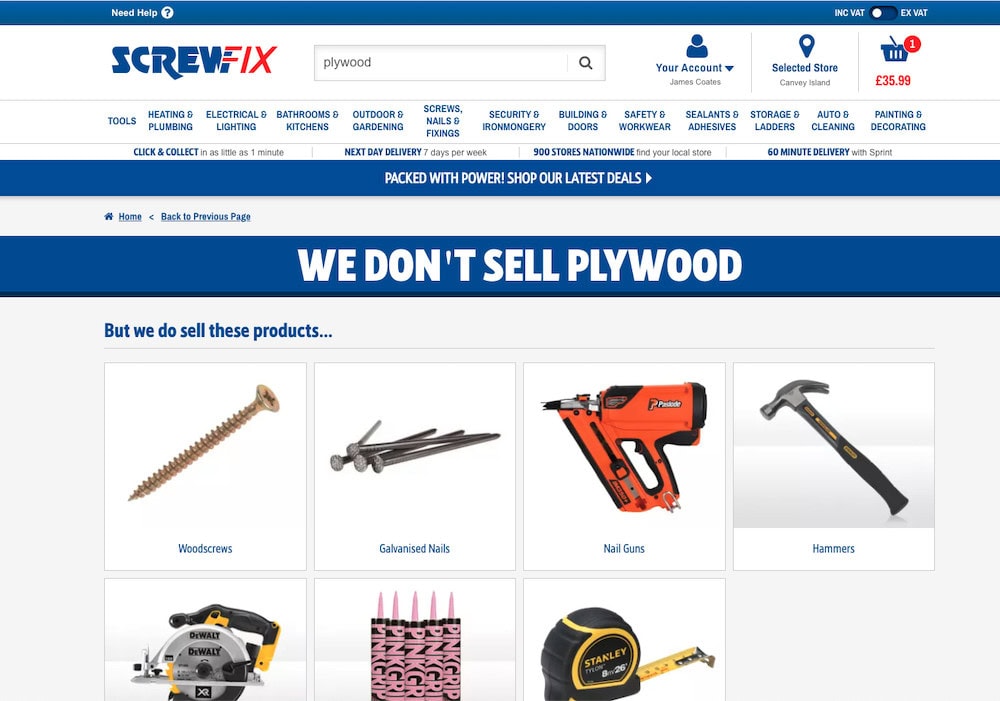
You’re on the Screwfix website and you’re looking for plywood again, after following the same approach looking at the product categories with no luck, you turn to the search bar.
Only this time, you’re directed to a dedicated page.
https://www.screwfix.com/landingpage/wedontsell-plywood

I’ve not come across this before, but I find it rather smart.
So at some point, the Screwfix team will have checked their internal site search queries, to discover that people are regularly searching for products they don’t sell, or they know that there are products in high demand that people are likely to be searching their site for.
Either way, where they’re not capitalising on this by adding the actual product to the catalogue, then they are creating destination pages specifically for those queries.
But they don’t sell the product, so why bother?
Good point, but the Screwfix team know their customers and that in this example, those buying plywood will most likely also need to buy nails, screws, nail guns, hammers, saws etc. Products that they do actually sell.
So in theory, they are creating opportunities out of nothing, and I take my hat off to them for this.
Does it work? I have no idea.
Is it clever? I think so.
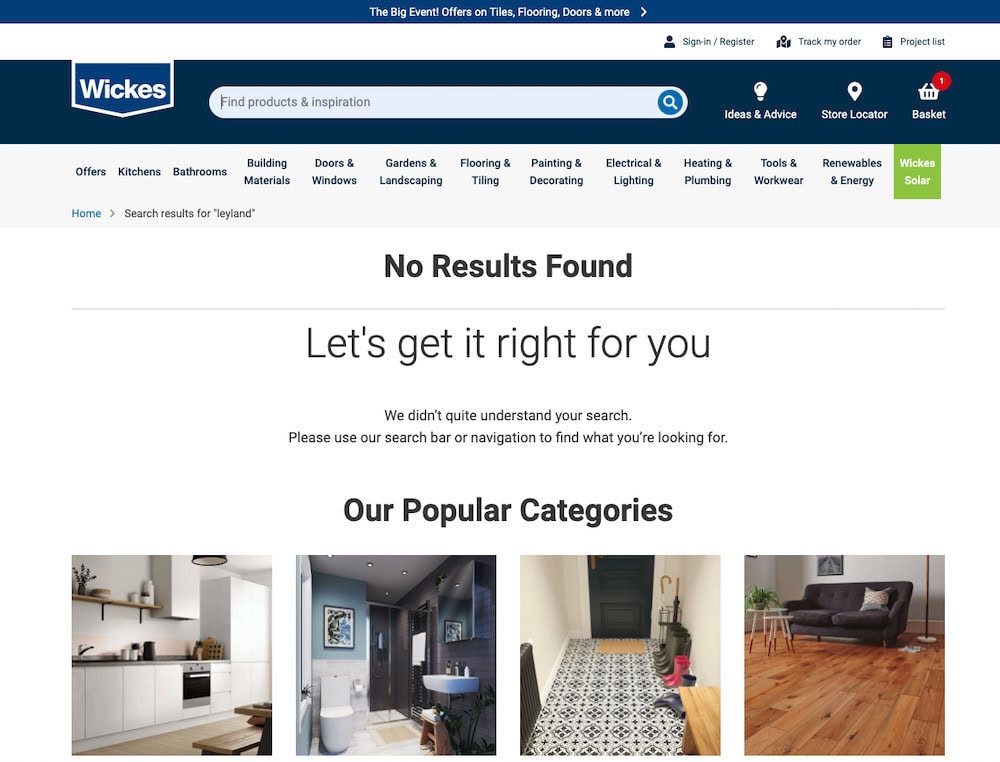
In another related search, I needed to buy some paint. Eventually I bought it from Screwfix, but I was going to my local Wickes store, so prior to visiting I searched the Wickes website for the paint I was after.
I was specifically looking for Leyland Paint.

Now, Leyland is a big brand of paint. Like plywood is a common type of wood, popular for DIY projects.
Screwfix sought out an opportunity to place products they do sell on a commonly searched product that they do not sell.
Wickes displayed zero results for my search. With some major players in the paint industry and competition brand names that people might also search for like Farrow & Ball, Valspar, and Leyland, this seems like a lost opportunity.
Directing users typing these common product searches to relatable product pages would be advisable. Like the painting and decorating page, or even just creating a page that says, hey we don’t sell Leyland, but we do sell Dulux and maybe include a comparison table for brands.
Update: when I wrote the notes for this article, the screenshot above was relevant. However Wickes now sell Leyland, and direct traffic for other searches like Farrow and Ball for example, to the painting and decorating page. So they have clearly taken note of what the competition is doing.
The key takeaways today are:
1. Understand your customers buying journey and know where your products and services fit into it.
Are there products or services you don’t sell that your customers buy frequently? How do yours complement these purchases? Does it warrant creating a page that showcases the items that most frequently work with the product or service?
2. Know your competition and popular products you don’t sell, and be able to direct users to an alternative.
Adding these product searches to display related or alternative products or services offers an opportunity. Like how searching for Farrow & Ball on Wickes now delivers you to the painting and decorating page. Or as suggested previously, a search for Leyland could show a page that says ‘we don’t sell Leyland, but we do sell Dulux, and Dulux is great because X Y Z’.
Something as small as creating a page for products you don’t sell can actually create sales opportunities. What if buying from you is more convenient? Or maybe they need complementary products? Maybe they don’t actually need the product they searched for, and the alternative suggestion will suffice or be better?
If you are not doing these things, you will simply never know.
That’s a wrap for Swipe & Deploy 067 this week. Join me next time where I will share another insight or inspiration piece from around the web.

If you’d like to learn more about our WordPress & WooCommerce Support & Maintenance plans, drop us an email or give James a call.
Our plans provide a holistic solution to your website’s performance, reliability and security, and are inclusive of premium tools and services.
Could adding verification by industry experts help build trust with your users, in a world where so much content is AI slop?
James Coates
A recent addition to the Oh Polly website went viral, and prompted this week's Swipe & Deploy. Could your brand take inspiration from Oh Polly for your own website?
James Coates
A look at how adding functionality for users to save their basket can remove friction and improve your chances of a sale.
James Coates