logo

WordPress Design Agency

020 3355 8747

Message Us
  • Home
  • About Impact®
    Learn More About Impact Media®
    • Meet The Team
       
    • Why WordPress
       
    • Careers
       
    • Giving Back
       
    • 100K Tree Challenge
       
    James Coates
    Schedule a discovery call with UX Specialist James
    Book A Call
  • WordPress Services
    Learn More About Our Services
    • WordPress Web Design
       
    • UX Design
       
    • WordPress Development
       
    • WordPress Support & Maintenance
       
    • WordPress Evolve Retainer
       
    • WordPress Multisite Development
       
    • WooCommerce
       
    • Replatform To WordPress
       
    • WordPress Consultancy
       
    • Integrations & Plugins
       
    • WordPress Managed Hosting
       
    • WordPress Health Check
       
    James Coates
    Schedule a discovery call with UX Specialist James
    Book A Call
  • Our Process
  • Case Studies
  • Insights
  • Contact Us
WordPress Design Agency
020 3355 8747
logo logo
Book A Call
Back
Menu
  • Home
     
  •  
    About Impact Media
    Learn More About The Impacters
    • Meet The Team
       
    • Why WordPress
       
    • Careers
       
    • Giving Back
       
    • 100K Tree Challenge
       
  •  
    Our Services
    Discover How We Can Help
    • WordPress Web Design
       
    • UX Design
       
    • WordPress Development
       
    • WordPress Support & Maintenance
       
    • WordPress Evolve Retainer
       
    • WordPress Multisite Development
       
    • WooCommerce
       
    • Replatform To WordPress
       
    • WordPress Consultancy
       
    • Integrations & Plugins
       
    • WordPress Managed Hosting
       
    • WordPress Health Check
       
  • Our Process
     
  • Case Studies
     
  • Insights
     
  • Contact Us
     
020 3355 8747
Mon - Fri • 9am - 5pm
Close

Oops! We could not locate your form.

Home / Insights / What Food & Drink Brands Need From Their Websites
Back

What Food & Drink Brands Need From Their Websites

Published 14.09.26
14th September 2026

Newer
15 Min Read
Rommel Plofino
Rommel Plofino
Web Design
Older
15 Min Read
 
Rommel Plofino
Rommel Plofino
 
Web Design

A look at some key things food and drink brand’s need from their websites, to provide customers with vital information and engage them effectively.

Food and drink is a pretty broad label. It covers everything from a global ingredients manufacturer with a product catalogue in twenty languages, to a small batch producer selling direct to consumers, or a hospitality venue that has a menu that changes every season.

What they all do have in common though, is, they need a website to do a lot more than just look good. These sites have to provide product information, allergen and dietary information, and trust signals that a buyers or potential diners want to see before committing.

  • Producers and manufacturers (ingredients suppliers, wholesale bakeries, food service suppliers) usually need a brochure style site (I accidentally typed brioche site first try, food on the mind!) with content like product ranges, technical specifications, ingredients, recipes, stockist or distributor information, and an enquiry route rather than a checkout.
  • Direct to consumers brands generally use an eCommerce platform like WooCommerce, and the site is built around clear product imagery, ingredients and allergen labelling at the point of purchase, and subscription or repeat order functionality if that is something they offer.
  • Hospitality and venue sites need menus, seasonal updates, allergen and dietary filtering, and often booking or enquiry functionality, with content that has to be kept current far more regularly than a typical brochure site.

Getting the framing right a the discovery stage is important, as it shapes everything downstream, from the CMS setup to the navigation, and if there are any important integrations required.

Having worked with a number of food and drink brands across manufacturing, retail, and hospitality, we’ve picked up a few patterns worth sharing if you’re planning a new site or auditing an existing one.

Structured Product & Range Information

For manufacturers and producers with a wide range, the product pages carry a lot of the commercial weight. When we redesigned and rebuilt Bakels Group’s sites (they are a global bakery ingredients manufacturer) this was one of the core challenges. A large product catalogue that needed to work across 25+ country sites, each with its own language and stockist information.

Bakels product and recipe structuring for easy filtering

We used custom fields to manage product and recipe data, so the Bakels team could update ranges, allergen information, dietary suitability, and nutritional details without needing a developer for every change. A dynamic stockist locator and PDF generation on the fly meant customers could find local distributors and pull documents without digging through static pages.

Bakels dynamic stockist locator

The same principle applies at a smaller scale. If you’re building or briefing a website for a food or drink brand with more than a handful of products, push for structured fields over free-text pages. It saves the business time on every future update, and it keeps allergen and nutritional data consistent, which matters more in this sector than most.

Allergen & Dietary Information

Food and drink is one of the few sectors where getting website content wrong has real legal and safety consequences, not just a bad user experience. Allergen labelling requirements (Natasha’s Law being the one most people recognise) apply to pre-packed food, but the expectation around clear allergen and dietary information has spread well beyond what is legally mandated. Diners and buyers now expect to filter by allergen or dietary need on a website before they ever place an order.

A few practical points worth building in from the start of a website project:

  • Treat allergen and dietary data as structured fields on the product or menu item, not paragraphs of copy, so it can be filtered, searched, and kept consistent with ease.
  • Make sure whoever own the day-to-day content updating can update allergen information quickly when a recipe or supplier changes.
  • Keep this content accessible. Correct semantic markup and colour contrast matter here even more than on a typical page, since this is safety critical information for some users.
Colour Contrast – The Easiest Accessibility Win Hiding In Plain Sight

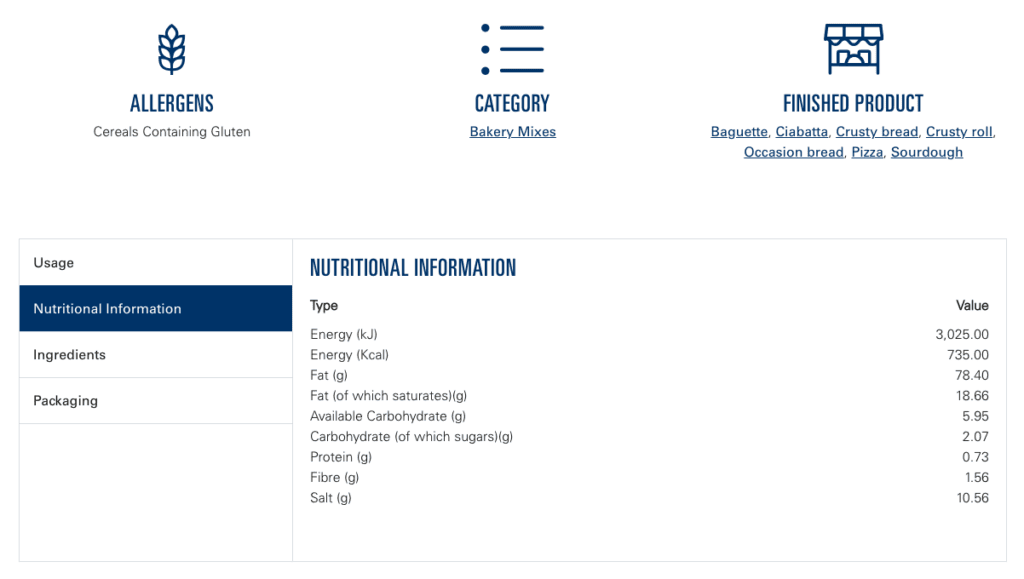
Here is an example from the sites we built for Bakels Group:

Bakels nutritionl information and allergens

For larger hospitality brands, there’s a second layer to remember. The Calorie Labelling (Out of Home Sector) (England) Regulations 2021, require businesses with 250 or more employees to display calorie on menus, including online menus and delivery platform listings. It doesn’t apply to every food and drink company, as many will sit under than threshold, but for ones that don’t, it’s a website content requirement as much as a physical menu one, and worth raising early in the project if you are a lager restaurant or cafe chain, or a pub group.

Appropriate Structured Data

Recipe and Menu schema are food and drink specific structured data types, but a lot of web design agencies forget about them, as they don’t often come up outside of this sector. Product schema is vital for any eCommerce business.

A Guide To Schema Markup For WordPress & WooCommerce Websites

Implemented properly, product schema can carry nutrition fields (ingredients, allergens, calories counts) alongside price and availability, so that information can surface directly within search results. Recipe schema does something similar for cook time, rating and ingredients. Neither tends to move rankings on their own, but both improve how a listing appears in the SERP, which can lift click throughs.

Age Verification For Alcohol

There are to parts to this that often get treated as the same thing, but are separate things that need to be considered.

1. The ‘are you 18 or over?’ pop up age gate that you see on most alcohol sites before you even enter the website, isn’t actually a strict legal requirement. It is more an industry self-regulation under the Portman Group Code of Practice, which expects alcohol marketing not to be easily accessible to under 18s amongst other things. So it is absolutely worth following suit with the bulk of the industry who have decided to respect these standards, with a front of site age gate as a straightforward, lowish friction marketing measure.

2. The actual legal requirements around selling alcohol online sit separately, under the Licensing Act 2003, and apply at the point of sale rather than at entry to the site. The penalties are a max fine of £5,000 for selling alcohol to a minor, and £20,000 for those who have persistent breaches, with the removal of alcohol licences as a potential outcome. So these are not something you want to fall foul of by not doing your due diligence.

As there’s some ambiguity in the guidance, about whether checks need to happen online at the point of sale, at delivery, or both, and in practice, how you handle age verification at the checkout is something you should confirm with your legal team, and then direct your web developer.

Multilingual Functionality & Multisite Needs Are Common

Food and drink brands trade internationally more often than people expect. Whether that’s a manufacturer supplying multiple markets, or a hospitality group with locations in different countries. If there is any chance of multiple languages or regional variants down the line, it is worth planning the information architecture for that early on, rather than trying to retrofit it later.

For Bakels, WordPress Multisite gave them a parent global site, and all of there (around 30) local sites under one installation, with WPML handing the translation where needed. This means that only one update has to be made to shared functionality for all sites, while each local team retains control over their own content and stockist details. This kind of setup is worth considering as soon as multiple regions or languages are even a possibility, not once you suddenly have ten disconnected sites to untangle.

The same approach works well for group companies with several distinct food or drink brands rather tan one brand across regions. Think a drinks group, a restaurant group or a food group with several consumer facing brands under the parent company. With multisite, each of these brands can keep its own design, domain and identity, run independently by its own marketing team, but the group can have overall control of hosting, updates, security and any shared functionality (a stockist locator or ingredients database for example) once, rather tan having to ensure it is done by each brand’s team on each site.

Photography Drives Conversions, So Must Be Optimised

Food and drink sites lean harder on photography than a lot of sectors. Product shots, recipe imagery, venue and menu photos, and more, which is why page speed and Core Web Vitals issues tend to creep in.

Large, unoptimised images are one of the most common causes of a slow website, and slow loads times impact conversion hardest on pages doing the most commercial work, like product and menu pages. Proper image compression, responsive sizing, and lazy loading below the fold should be standard on any food and drink site, not an afterthought.

Image Compression And Its Benefits For Website Performance

Trust Signals & Provenance

Buyers in food and drink, whether that is a trade customer, a retail shopper, or a restaurant diner, tend to care about provenance, sourcing and credential more than in most other sectors. That’s worth reflecting in the site structure, not just as a page, but as a thread throughout product pages, an about section, and case studies or customer logos where relevant.

Below is an example from the site we built for food and drink adjacent manufacturer, Farleygreene, that provide sieving machinery to the food and drink industry:

farleygreene food & drink customer logos

For manufacturers this often mean visible accreditations, sourcing information, and clear support content. For consumer facing brands, it’s more likely to be about a story. Where the ingredients come from, how something is made, and who is behind it. Either way, it is not content to leave as an afterthought once the rest of the site is built.

Peak Seasons Preparedness

Generic peak season advice tends to centre on Black Friday and Christmas, and for food and drink brands those matter, but so do dates that don’t show up on most retailers calendars. The likes of Valentine’s Day, Mother’s Day, Easter and the Summer BBQ season can all drive spikes as sharp as Black Friday for the right food or drink brand.

We’ve covered the technical side of peak season readiness in more detail in our Is Your WordPress Website Holiday Ready?, most of which applies just as well to a Valentine’s Day or Mother’s Day traffic surge. But the main takeaway is that you have hosting infrastructure that can handle sudden peaks, and reliable support on hand should anything go wrong.

Is Your WordPress Website Holiday Ready?

Security Taken Seriously

Food and drink websites, particularly those with an online store or customer accounts, are as much a target for common vulnerabilities as any other site. This isn’t a food and drink specific issue, but it is worth flagging here because so many of these sites hold customer data, allergen preferences, and order history that needs protecting properly.

  • A web application firewall (WAF) to filter malicious traffic before it reaches the site (we use Cloudflare, and Sucuri remains a solid option too).
  • A clear plugin and core update process, tested on staging before going live.
  • Managed hosting with proper backups.
WTF Is A WAF? Securing Your WordPress Website With The Right Firewall

There’s no single template for a food and drink website, because the sector covers manufacturers, retailers, and the hospitality business, with varying needs. What they do share, however, is a higher bar for structured, accurate product and allergen data, and buyers who expect that information to be easy to find.

Starting with a clear view of what your website needs to do for your audience, before a single wireframe gets created, is what makes the rest of the build straightforward, and delivers a useful and engaging website.

If you’d like to talk through a website for your food or drink brand, get in touch with the team.

A picture of James Coates.

Impact Media® has been crafting award-winning websites since 2003.

If you’d like to learn more about our website redesign approach and if it could be a good fit for your organisation, drop us an email or give James a call.

button to visit contact page

Share Socially
Rommel Plofino
Rommel Plofino
WordPress Developer
Rommel has many years of experience as a full-stack web developer and is very passionate about WordPress.
View Team Profile
See More Articles
Rommel Plofino
Rommel Plofino
WordPress Developer
Rommel has many years of experience as a full-stack web developer and is very passionate about WordPress.
See More Articles
View Team Profile
Let's Get The Ball
Rolling On Your New Website
Give us a call or drop us a message, to see if we could be the right fit for your project.
Let's Chat
studio@impactmedia.co.uk
020 3355 8747
Impact Media's LinkedIn
Impact Media's Twitter
Impact Media's Facebook
Impact Media's Instagram
Impact Media's Youtube
wordpress.org

About Impact

  • About Impact Media®
  • Meet The Impact Team
  • Why WordPress?
  • Our Web Development Process
  • Careers
  • Awards
  • Partners
  • Giving Back
  • 100K Tree Challenge

WordPress Services

  • WordPress Web Design
  • UX Design
  • WordPress Development
  • WordPress Evolve Retainers
  • WooCommerce Development
  • Multisite WordPress
  • Migrate To WordPress
  • Custom Integrations & Plugins
  • WordPress Consultancy

WordPress Support

  • WordPress Support & Maintenance
  • WordPress Managed Hosting
  • Case Studies
  • Insights
  • Contact Us

Addresses

London Address:

50 Liverpool Street,

London, EC2M 7PY, UK

+44 (0) 20 3355 8747


Registered Address:

Woodland Place, Hurricane Way

Wickford, SS11 8YB, UK

  • Privacy Policy
  • Cookie Policy
Impact Media logo
© Impact Media® 2003 - 2026
Impact Media is a trading name of IMDMS LTD. Company Reg. 05970261
Impact® & Impact Media®
are registered trademarks of IMDMS LTD