
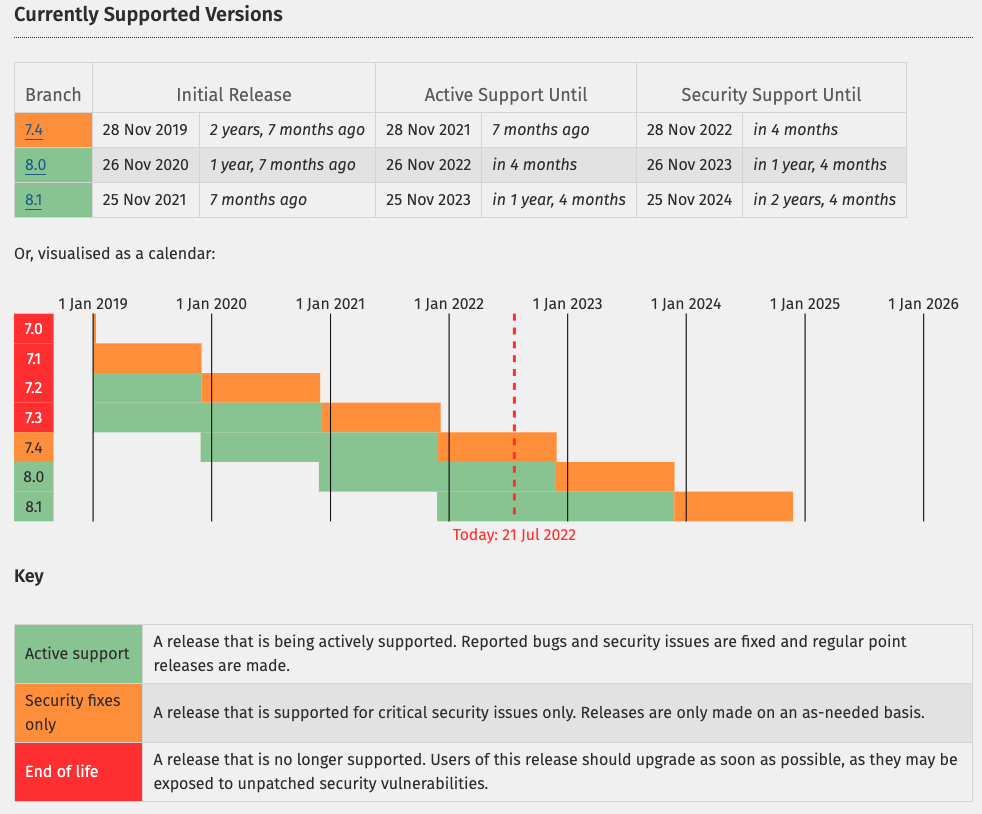
In November this year, security support for PHP 7.4 will cease. This follows on from active support ending last November. This brings to an end, the entire version 7 branch of PHP.
If your website isn’t already on the version 8 branch, you will need to rectify this to ensure its ongoing security.
You can monitor version releases and support on the PHP website, where they regularly update the table shown below:
How To Find Out Which PHP Version Your Site Is Using
You can find out what version of PHP your website server is using via the Site Health area in your WordPress backend.
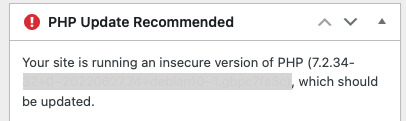
On your main dashboard page, you may receive a warning that looks like this example I found from a site on PHP 7.2:
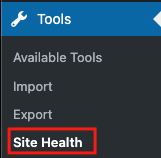
If not, you will want to go to the Tools section in your WordPress dashboard. Under Tools, you will see Site Health. Click to access this section.
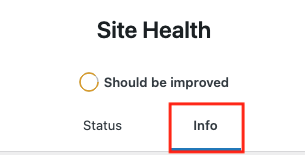
Once there, click across to the Info tab, which will bring up a list of information sections.
You want to click on Server, and it will open up a table of information relating to your server set-up. Close to the top, you should see PHP Version.
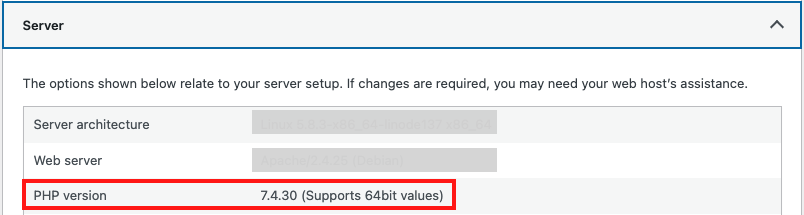
If this is anything lower than 8.0, as in the example above, you need to action getting moved over to a server running a supported version of PHP.
PHP Updates – Versions & Branches
PHP has a formal specification, and it is continuously worked on and evolved to improve performance and security. As such it receives regular updates, and older versions lose support as they are are surpassed by newer versions.
PHP Branch Updates
Some updates are smaller branch updates within a version. Version 7 had 4 branch updates after its initial release – 7.1, 7.2, 7.3 and 7.4.
Upgrading through the PHP releases within a version branch rarely brings any major changes, so is less likely to cause issues as a result.
PHP Version Updates
However, some updates are the much bigger version updates, which are luckily far fewer in frequency (roughly every 5-10 years). These new versions are permitted to break the backward compatibility of code in order to make broader and more impactful changes.
As a result, upgrading across versions (in this case, between 7 & 8) isn’t always as straightforward. When this backwards compatibility gets broken, it can cause compatibility issues for websites and plugins built to be compatible with older versions.
PHP 8.0
PHP 8.0 is a major update of the PHP language. It contains many new features and optimisations, which bring enhanced security and performance. This does also mean that it increases the likelihood of issues resulting from broken backwards compatibility.
The most recent version of PHP currently available is 8.1. Version 8.0 will continue to be actively supported until November this year, and will retain security support until November 2023.
PHP & Website Hosting
Most web hosts will automatically push their customers onto a server running the latest version of PHP with little thought for compatibility. This is in order to maintain a secure service with optimised performance.
However, the knock-on effect of this can be that any websites that have code that is incompatible with that PHP version, will experience issues.
This is less likely to be severe with the minor branch updates but becomes far more likely to create problems when moving to a new version.
This also applies to the plugins in use on those websites. Premium plugin developers are usually fairly quick to bring their code up to date and release new compatible versions. Even then, there can be a period before patching, where they don’t play well. For smaller plugin developers, or those that aren’t well maintained, this can take a long time, or may never happen.
So What Does This Mean For A Website?
Incompatibilities between the server hosting a website, and the website’s code and plugins can lead to problems.
Functionality may break, and plugins may not work or function as expected. The website might start getting a lot of error messages, and in some cases might experience the dreaded ‘white screen of death’.
Our PHP Process & Solution
To avoid the issues listed above, we don’t automatically push our client’s websites onto a server with the latest PHP version as soon as it releases. We understand how much a website that isn’t fully functional can cost a business.
We take a more protective approach to ensure no interruptions to business.
When a new version comes along, we secure additional time with our support clients to run a full audit of their code and plugins. This then gives us an understanding of what work is required to bring their website up to scratch, so that it will have no compatibility issues when moving to an upgraded server.
If major work is required (generally on sites we’ve not built but support, especially those using off-the-shelf themes) we require additional development time outside of the support retainer to make the code compatible and find plugin alternatives where possible, or in some cases build alternatives ourselves.
Once this work is carried out, we can safely move the client’s website over to a server running the latest PHP version, secure in the knowledge that everything will work correctly.
How We Can Help You
WordPress Audit
Our WordPress Health Check audits can take a deep dive into the build and hosting environment of your website.
This is on top of a huge number of other checks, that will delve into the security, performance, and health of your website. Our findings will be presented back to you and included in a report, which will also contain a list of recommendations to improve your WordPress website. We will also provide a no-obligation quotation for improvement work.
Support, Maintenance & Hosting Plan
If you’re not satisfied with the level of support and communication you have with your current hosting provider, or need a more proactive and responsive support and maintenance partner, our Support & Maintenance plans for WordPress and WooCommerce websites could offer the perfect solution.
Our plans offer the benefit of WordPress technical experts managing the everyday maintenance and support needs of your website. We take all of this off your plate and give you peace of mind through responsive support with real humans ready to help and just a call away. We’ll even liaise with your 3rd party suppliers when required, to take another time-consuming task off your hands.
Most of our plans also include premium managed hosting, in an environment optimised to get the best performance out of your WordPress website. It will be protected with a rock-solid DNS-level firewall, alongside a range of other features and perks designed around stability and performance for digital critical businesses.
As an added extra, we plant trees monthly for every one of our support clients. You can check out our progress over at Ecologi, or learn about our 10K Tree planting challenge.
To Find Out More
To see how other brands have benefitted from our support & hosting services, take a look at our case studies for Tollring, Automation Logic, and Tungsten Publishing.
You can also check out reviews and feedback from our clients in the following places:



If you’d like to know more about how we can support you with your WordPress or WooCommerce website, drop the team a message or give us a call.