logo

WordPress Design Agency

020 3355 8747

Message Us
  • Home
  • About Impact®
    Learn More About Impact Media®
    • Meet The Team
       
    • Why WordPress
       
    • Careers
       
    • Giving Back
       
    • 100K Tree Challenge
       
    James Coates
    Schedule a discovery call with UX Specialist James
    Book A Call
  • WordPress Services
    Learn More About Our Services
    • WordPress Web Design
       
    • UX Design
       
    • WordPress Development
       
    • WordPress Support & Maintenance
       
    • WordPress Evolve Retainer
       
    • WordPress Multisite Development
       
    • WooCommerce
       
    • Replatform To WordPress
       
    • WordPress Consultancy
       
    • Integrations & Plugins
       
    • WordPress Managed Hosting
       
    • WordPress Health Check
       
    James Coates
    Schedule a discovery call with UX Specialist James
    Book A Call
  • Our Process
  • Case Studies
  • Insights
  • Contact Us
WordPress Design Agency
020 3355 8747
logo logo
Book A Call
Back
Menu
  • Home
     
  •  
    About Impact Media
    Learn More About The Impacters
    • Meet The Team
       
    • Why WordPress
       
    • Careers
       
    • Giving Back
       
    • 100K Tree Challenge
       
  •  
    Our Services
    Discover How We Can Help
    • WordPress Web Design
       
    • UX Design
       
    • WordPress Development
       
    • WordPress Support & Maintenance
       
    • WordPress Evolve Retainer
       
    • WordPress Multisite Development
       
    • WooCommerce
       
    • Replatform To WordPress
       
    • WordPress Consultancy
       
    • Integrations & Plugins
       
    • WordPress Managed Hosting
       
    • WordPress Health Check
       
  • Our Process
     
  • Case Studies
     
  • Insights
     
  • Contact Us
     
020 3355 8747
Mon - Fri • 9am - 5pm
Close

Oops! We could not locate your form.

Home / Insights / Wireframes: The Secret Sauce For Improving UX In Web Design
Back

Wireframes: The Secret Sauce For Improving UX In Web Design

Published 04.11.20
4th November 2020
Last Updated 24.09.25
24th September 2025

Newer
13 Min Read
Joe Dawson
Joe Dawson
UX & CX
Older
13 Min Read
 
Joe Dawson
Joe Dawson
 
UX & CX

They may sound obscure. But wireframes are actually a core part of the web design project, helping you prioritise UX and reducing subjectivity in the success of your web development project.

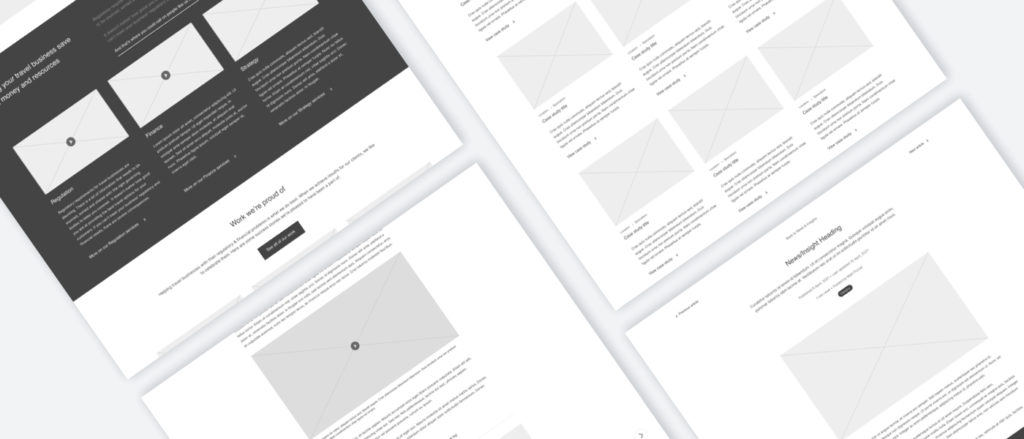
UX Wireframes

The process of conceptualising and designing a website is complex. It requires so many steps, you may think of some of them as superfluous. Do you really need an extra step to build abstract layouts of individual pages, before actually building the pages themselves?

The short answer is yes. Wireframes can enhance a website design project in a variety of ways. In fact, they may just be the secret sauce for making it successful.

To get to that point, of course, you have to understand both the concept and its benefits. Join us for an explanation of what wireframes actually are, and why they should always be part of a website design project.

First Things First. What Is A Wireframe?

Let’s start with a basic definition. A wireframe is:

“a two-dimensional illustration of a page’s interface that specifically focuses on space allocation and prioritisation of content, functionalities available, and intended behaviours.“

usability.gov
wireframes from the TTC website
An Example Of Some Desktop Wireframes

In other words, it’s a basic layout of what a particular page on your website might look like. Wireframes focus on layout, not design. So rather than incorporating the distractions of colour and imagery, their purpose is to show the relationships between the various elements of a page design.

Elements like:

  • the hero image
  • the navigation
  • main content areas
  • where graphics and images will sit
  • calls to action
  • testimonials

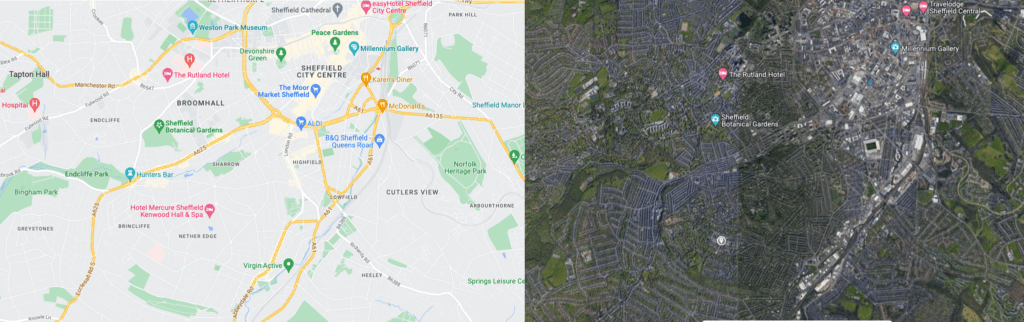
They’re like a map, as opposed to an aerial photograph. All of the important areas and features are represented simplistically and in their correct positions. Better enabling an understanding of how they all relate to one another. Whereas an aerial photo would make navigation and spacial understanding harder, with all of the additional distracting visual information.

example of a map of Sheffield vs an aerial photo of the same area
Sheffield Map vs Sheffield Aerial Photo

6 Ways In Which Wireframes Will Improve Your Website Project

You might think that wireframing is an optional additive. Technically, that might be true as you can go through an entire web design project without them.

However, starting with the look and feel of a site will prioritise page aesthetics over pages and layouts that deliver frictionless and simple user journeys. It is the latter that will actually lead to a converting website.

You can skip wireframes, but that doesn’t mean you should. Building these basic layouts before you get into the visual design stage is beneficial in more ways than one.

Visualising your information architecture on desktop and mobile devices and ensuring that user journeys are properly laid out. Giving direction to web content creation, and saving valuable time. Here are a few of the reasons why wireframes should be a central part of any web design project.

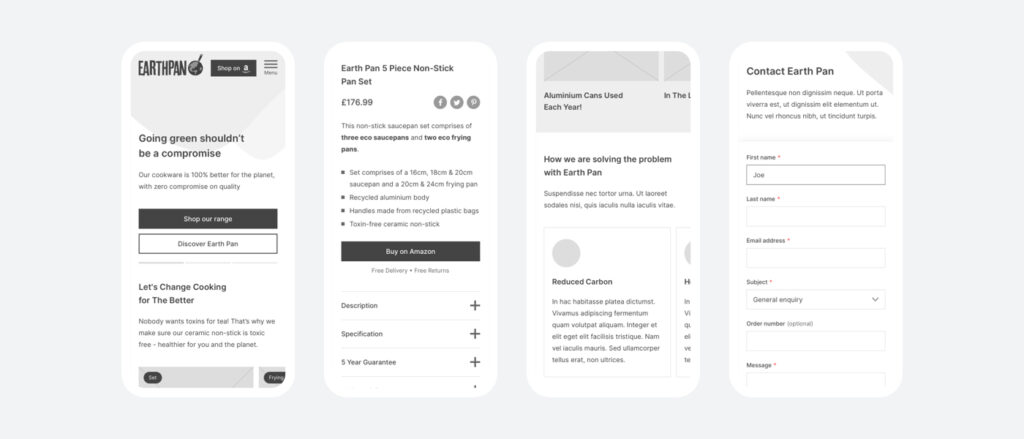
Earth Pan mobile website wireframes

1) Wireframes Keep The Focus On Usability

The primary reason for creating wireframes is to keep your website functional and user-focused. Your visitors need to easily find their way to the content they need, regardless of where it might be placed. That unclouded focus on user experience is impossible if you put design ahead of basic layout and structure.

I’ve seen many impressive-looking websites that have even won prestigious design awards, but they are a usability nightmare. They don’t actually cater to their users’ needs, and so in real terms, they’re not a success. They may look exciting but usually fail to deliver on the basics of what most businesses and their users require from a website.

These websites usually rely on things like hiding the navigation and unusual layouts. They’ll be virtually text-free, or incorporate different media types to look cool. As a result, their visitors usually struggle with the experience as it hasn’t been built with their needs in mind. Marketers struggle with a website that doesn’t convert and doesn’t perform well in organic search.

It’s a bit like having a garment from one of the more concept-heavy fashion catwalks. Beautiful to look at, but impractical to wear day to day.

Wireframes allow you to get the best of both worlds. You can focus on usability first, then layer the design in to serve that usability. Your visitors will be happier, and you’ll be more likely to build a website that’s an actual business asset.

2) Wireframes Visualise Your Information Architecture 

Wireframes allow you to understand exactly how the various elements of your core pages relate to each other. You can begin to understand exactly where a headline will stand in relation to the hero image, or how much attention the main CTA gets.

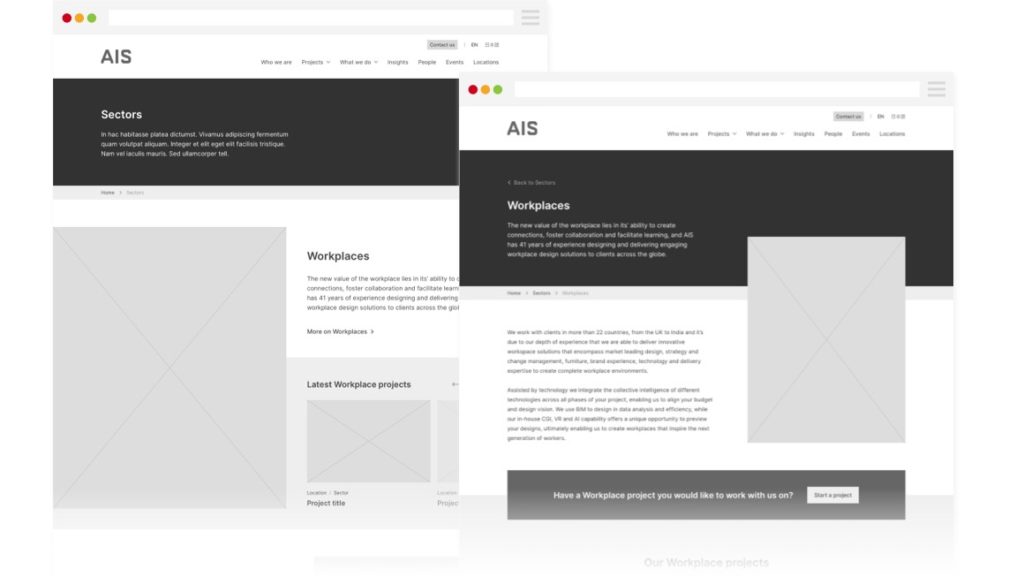
This is especially true when you create wireframes for each of the various page types you expect your website to have. Your homepage might follow a different layout than your product pages, and yet they might need to have certain elements in common. For example, the site header and primary navigation.

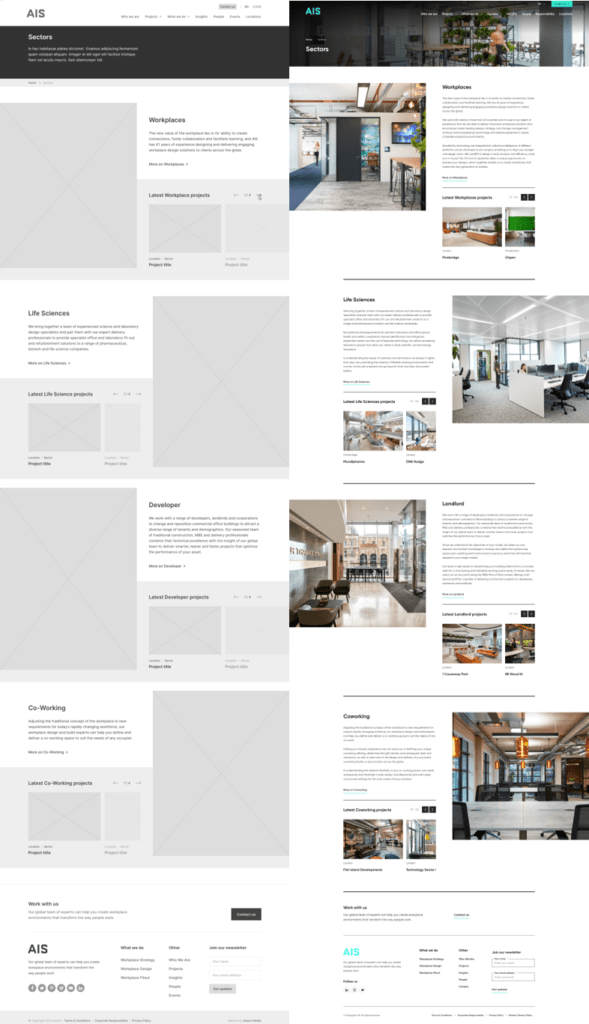
AIS Wireframes - Sectors and Workplace pages
Example Of Wireframes For Different Page Types

In other words, your wireframes demonstrate how your website will function. You can test how additional content might flow on desktop compared to mobile devices, or how a complex multi-tier navigation will work on mobile devices.

A visual representation of that flow helps you better understand usability. It increases your focus on how the information all ties together.

3) Wireframes Focus Your Content And Layout

If you jump straight into the design of a website you might be blindsided by a great visual, or distracted by a colour choice you’re not sure about. With this vying for your attention, it could hide some real content or layout problems.

By using wireframes, you can put content and layout first. Creating the right hierarchies and focus areas for your audience to pay attention to.

By utilising wireframes, you can account for typical online reading patterns. You can also avoid the placement of content that may be difficult to find or read. You can ensure that your important CTAs are visible and not lost in the flow.

By putting content and layout first, you can build your website from a functional perspective, rather than focusing on visuals.

Visual design can come once you have a rock-solid foundation and blueprint for your page design. You wouldn’t build a house by beginning with the brick colour and pattern. You’d start with architectural plans followed by constructing a proper foundation.

Think of your wireframes as your architectural plans that allow you to lay a functional foundation and proceed confidently with your build.

4) Wireframes Speed Up Content Visualisation

A good website strategy workshop should include an effort to plan an outline of content. As it ultimately makes up the meat of your site.

However, that content might not be ready during the early stages of a project. If that’s the case, wireframes become invaluable for mapping out the content required and the way the content flows.

For instance, a wireframe might show an about us page that has a section for a 300-word introduction. This might be followed by a paragraph inviting users to meet the team. That paragraph could be accompanied by space for a team photo and copy that directs users to a full meet the team page.

Building the wireframe means that this content doesn’t need to be ready yet. Rather, it can provide a map of precisely what content is required to be ready by the time content loading begins.

Then a marketing team can set about creating new content for the predefined areas. It will also offer guidance on what imagery needs to be sourced or created.

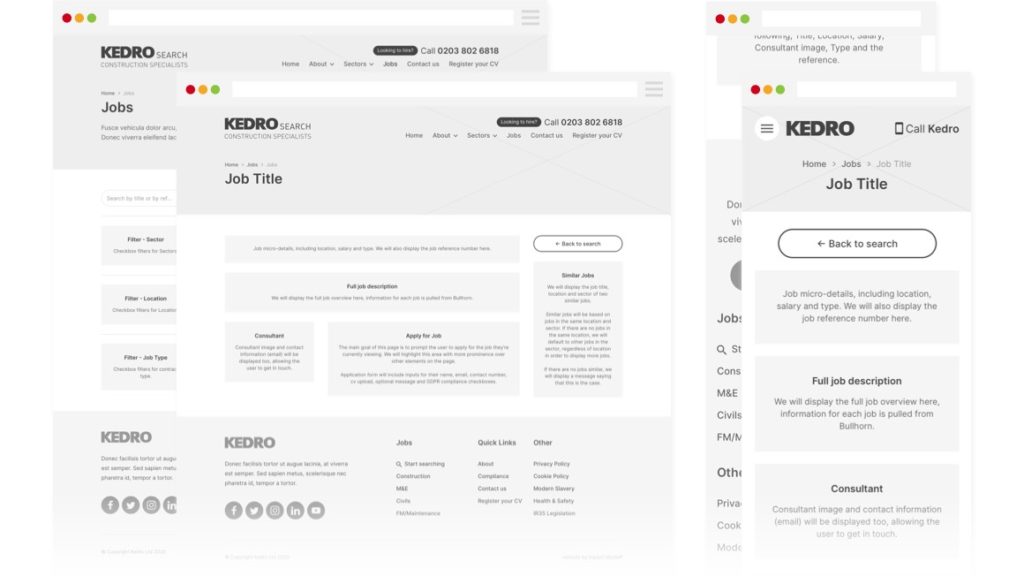
Kedro wireframes for Jobs pages
An Example Of A High Fidelity Wireframe

Wireframes can also be a great reminder for those little bits of copy and microcopy that often get overlooked. Despite them often being vital and in need of careful crafting. The likes of button copy, CTAs, form copy, image ALT text, image captions, H1s and other headers.

For a copywriter or marketing team, a wireframe better focuses their work by giving it context. So they aren’t starting with a blank space and vague idea of word count.

5) Wireframes Allow For User Testing

User or usability testing is the process of collecting insights and feedback from real members of your target audience. In web design, this is feedback on interacting with your website. It’s a core component of any user experience-focused website strategy.

It helps you to avoid making decisions based on opinion, instead making them based on and backed up by real data.

User testing can be carried out on a live website to inform changes or a future redesign. It can be done on a production website to see if it’s on track or in need of important changes. Or it can be done using wireframes and prototypes.

High-fidelity wireframes or a prototype website created using them, allows you to start the process early. Potentially preventing costly changes or delays further into the process. Before you even begin to build a website, you can gather insights on whether your potential customers are on board with your information architecture, and if they can achieve their goals without friction.

That, in turn, allows you to make any adjustments based on their feedback, before going too far in the wrong direction. 

6) Wireframes Save Time And Resources

Finally, although they may seem like an additional step and more expensive in the short term, wireframes can actually have the opposite effect in the long run. That’s because they build a more iterative web design process, allowing for earlier and more productive feedback that streamlines the entire process.

Design is largely subjective, but content and layout are typically not. Focusing on the latter first, pushes the subjectivity to a later stage where it can be held in check by decisions already made on layouts, that were based on actual data and user requirements.

The designs are more calculated, the designers know what to hold on to and you become less likely to need to backtrack or start from scratch. It also drastically reduces the risk of a finished website that fails to perform and needs another costly redesign in a short timeframe.

ais wireframe alongside designed page
Example Of A Wireframe Alongside The Final Design

The Value Of Wireframes In Building A UX-Focused Website  

Make no mistake, any web design expert will advocate for wireframes for the exact same reasons listed above. The extra data, care, and consideration of the end user in relation to your layout and information architecture will pay off in the long run.

Wireframes allow you to quickly see what’s missing or misplaced, where user journeys don’t flow, and to refine functionality and user-friendliness first before getting into the design nuances.

That’s why finding a UX-led web design partner, and budgeting time and resources for a wireframing stage makes sense. It helps you get on the right track but most importantly, it prioritises user experience in a way that starting out with design simply can’t.

Wireframes and UX Design are a vital part of a successful website strategy and should be a priority early on in your design or redesign process.

Impact team at UK Dev Awards

Is It Time For A Website Redesign?

If you’d like to learn more about our website redesign approach and if it could be a good fit for your business, drop us an email or give us a call.

Share Socially
Joe Dawson
Joe Dawson
Head of Digital
Joe is Head of Digital at Impact. His expertise are UX and design, but he's also a highly experienced web developer. He's been designing and building websites since he was at school. These days he likes to attend as many WordPress conferences as possible, to continuously expand his skills.
View Team Profile
See More Articles
Joe Dawson
Joe Dawson
Head of Digital
Joe is Head of Digital at Impact. His expertise are UX and design, but he's also a highly experienced web developer. He's been designing and building websites since he was at school. These days he likes to attend as many WordPress conferences as possible, to continuously expand his skills.
See More Articles
View Team Profile
Want more control over
how you manage content in WordPress?
Edit content that was previously restricted and get creative with building pages in WordPress.
Let's Chat
studio@impactmedia.co.uk
020 3355 8747
Impact Media's LinkedIn
Impact Media's Twitter
Impact Media's Facebook
Impact Media's Instagram
Impact Media's Youtube
wordpress.org

About Impact

  • About Impact Media®
  • Meet The Impact Team
  • Why WordPress?
  • Our Web Development Process
  • Careers
  • Awards
  • Partners
  • Giving Back
  • 100K Tree Challenge

WordPress Services

  • WordPress Web Design
  • UX Design
  • WordPress Development
  • WordPress Evolve Retainers
  • WooCommerce Development
  • Multisite WordPress
  • Migrate To WordPress
  • Custom Integrations & Plugins
  • WordPress Consultancy

WordPress Support

  • WordPress Support & Maintenance
  • WordPress Managed Hosting
  • Case Studies
  • Insights
  • Contact Us

Addresses

London Address:

50 Liverpool Street,

London, EC2M 7PY, UK

+44 (0) 20 3355 8747


Registered Address:

Woodland Place, Hurricane Way

Wickford, SS11 8YB, UK

  • Privacy Policy
  • Cookie Policy
Impact Media logo
© Impact Media® 2003 - 2026
Impact Media is a trading name of IMDMS LTD. Company Reg. 05970261
Impact® & Impact Media®
are registered trademarks of IMDMS LTD