


Edit: This post received a full update in May 2026, to ensure ongoing accuracy and value.
By now, if you’ve been following any news about GA4 or Google Ads, you’ve almost certainly heard of Consent Mode. Originally introduced by Google in 2020 and updated to v2 in late 2023, it has since become one of the most important technical requirements for any business using Google’s advertising or analytics tools.
So What Is It?
According to Google, “Consent Mode lets you communicate your users’ cookie or app identifier consent status to Google. Tags adjust their behaviour and respect users’ choices.”
In plain English, if a user consents to being tracked, you can track them with Google Tags. If not, then you can’t.
This works in combination with your cookie management platform. So that when a user sets their consent preferences, Google Tags will be updated accordingly.
But as a marketer, doesn’t that mean you’ll lose loads of data? Well yes, but also no.
Depending on which version of Consent Mode you’ve implemented, some anonymous signals can still be sent that allow Google to model what it can no longer directly measure.
Consent Mode Has 2 Implementation Methods
This is why Advanced Consent Mode exists. It uses pings and a bunch of built-in modelling to provide an advertiser-specific model. Google says that Advanced Consent Mode is GDPR compliant, but some are unsure whether this is accurate.
For those not wishing to risk it until more clarity is provided, Basic Consent Mode can be used. Basic Consent Mode means that the pings and modelling used by Advanced Consent Mode are not available So if a user doesn’t provide consent, no data will be received.
We’ll cover these 2 modes in more depth shortly.
Why Does Consent Mode Exist?
Consent Mode has had to be introduced because there are a lot of data privacy laws being introduced around the world. We all know about GDPR (I hope!), but there are also newer laws like the CCPA (California Consumer Privacy Act) and a growing number of equivalents elsewhere.
The practical result is that a significant proportion of your website visitors will decline tracking cookies. Research from etracker’s 2025 Cookie Consent Benchmark Study found that with a legally compliant banner design, an average of 60% of visit data is lost, and in markets like Germany and France, cookie acceptance rates can fall below 25%. Consent Mode exists to help you work within those privacy constraints while recovering as much measurement insight as possible through anonymous modelling.
So How Does All Of This Work?
Consent Mode interacts with with your cookie management platform to send your user’s consent preferences to Google. These consent preferences are divided into several consent types, governed by what the data is used for by Google.
Consent Mode V1
Version 1 has now be surpassed by Version 2. Version 1 provided the following consent signals to be sent Google:
- ad_storage
- analytics_storage
- functionality_storage
- personalization_storage
- security_storage
Consent Mode V2
Version 2 is now the default and adds these additional consent signals:
- ad_user_data
- ad_personalization
Without these two additional signals correctly configured, Google cannot build or target remarketing audiences from EEA/UK users, track conversions accurately, or deliver personalised advertising to those users. As Google’s enforcement has tightened, accounts missing these signals have found their campaign performance, and their data, significantly impacted.
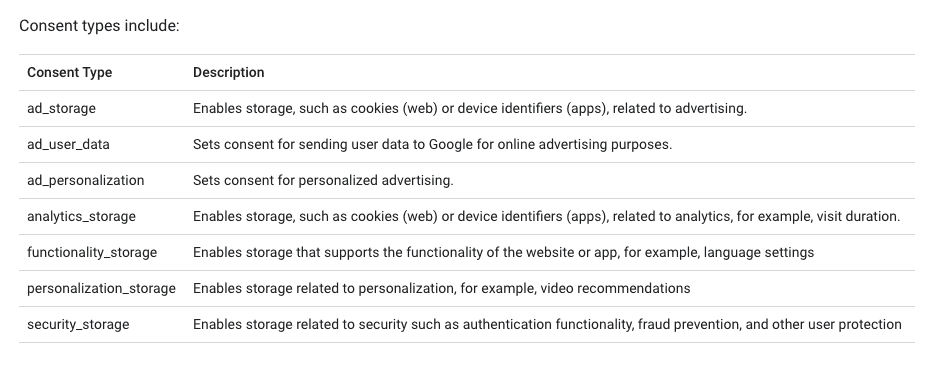
Here each consent type is summarised by Google:
The Two Implementation Options – Basic vs Advanced
There are 2 ways to implement Consent Mode, depending on the level of compliance and restrictiveness that you wish to opt for. This will be up to you on an organisational level, and potentially should include your legal team.
As already mentioned, although Google has said that Advanced Consent Mode is GDPR compliant, many organisations choose to avoid any risk and implement Basic Consent Mode.
Basic Consent Mode
With Basic Consent Mode, Google tags are blocked entirely until a user gives consent.
If consent is granted, everything exists as normal. Users are tracked, and you know what pages they visited, what they bought, and what they interacted with.
If consent is not granted, there are no cookies stored so you do lose the data.
This was previously seen as the more cautious option from a compliance standpoint. The trade-off is that for EEA and UK traffic, where opt-out rates are typically high, you have no measurement or modelling capability for the majority of your users.
Advanced Consent Mode
Advanced Consent Mode is the recommended implementation for most websites, and the one that has the most meaningful impact on your advertising and analytics performance.
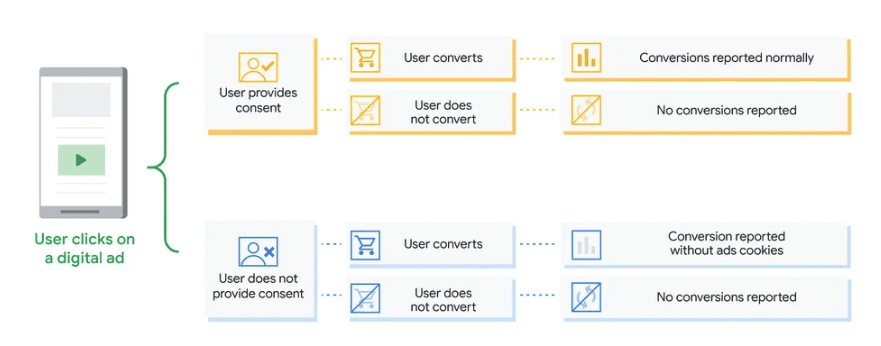
With Advanced Consent Mode, you thankfully don’t lose everything if a user doesn’t grant consent.
Google still communicates a very minimal amount of information about those users.
It communicates:
- Conversion pings (a conversion happened)
- Analytics pings (sent from any page the user visits that has analytics implemented and events happen). Remember, page views are now events.
Consent Mode allows you to customise how Google tags behave before and after user consent decisions, via Google Tag (gtag) or via Google Tag Manager (GTM).
You Mentioned Pings?
I did. There are quite a few of these (and this may well turn into another blog entirely), but there are:
- Google Ads Consent Status pings – These are Consent status pings that are sent from every page that has implemented consent mode (that a user actually visits). These also fire if consent is changed (someone may grant consent where they hadn’t consented before).
- Conversion pings – These let you know that a conversion has occurred (remember every conversion is an event, but not every event is a conversion).
- Google Analytics pings – These fire on every page where analytics is implemented and an event has been triggered (page views are events remember).
Great…what?
Basically, when consent is granted, all the tags implemented work as expected. If consent isn’t granted, then the tags adjust accordingly.
But What Is A Ping?
According to Google’s documentation (you can find that here) Consent Mode pings can include:
Functional information (such as headers added passively by the browser):
- Timestamp
- User Agent
- Referrer
Aggregate or non-identifying information:
- An indication for whether or not the current page or a prior page in the user’s navigation on the site included ad-click information in the URL (for example, GCLID or DCLID)
- Boolean information about the consent state
- Random number generated on each page load
- Information about the consent platform used by the site owner (for example, Developer ID)
All of this is to say that if consent is denied, instead of cookies being stored, your tags send pings to Google.
If you are using GA4 (which if you are reading this blog you probably are), Analytics fills any data gaps with modelling (both conversion and behavioural).
A Note On GDPR Compliance
Above I noted that some organisations are uncertain whether Advanced Consent Mode is fully GDPR compliant. This is worth addressing directly, because the landscape has moved on since v2 first came into use.
The cookieless pings sent by Advanced Mode do not use cookies or persistent identifiers, and do not transmit personal data in the way that full tracking does. Google’s position, that Advanced Mode is GDPR compliant, has not been successfully challenged, and the broad majority of privacy and legal professionals working in this space now treat Advanced Mode as the appropriate default for EEA/UK websites. If your organisation has specific legal concerns, consulting your own legal team remains sensible, but the previous uncertainty around this has largely resolved in practice.
Why Should I Implement Consent Mode?
Consent Mode v2 became mandatory for EEA and UK advertisers in March 2024. Since then, enforcement has tightened significantly.
If you use Google Analytics or Google Ads, not implementing Consent Mode will mean a loss of data and of certain advertising features:
“To keep using measurement, ad personalization, and remarketing features, you must collect consent for use of personal data from end users based in the EEA and share consent signals with Google. The requirements also apply if you are using Google Analytics data with a Google service.”
Google
If you use Google Ads and your site doesn’t collect user consent, you may have seen the following warning notice for a period of time:

In July 2025, Google began actively disabling personalisation, remarketing, and conversion tracking for accounts that hadn’t implemented correct consent signals. Developers and advertisers documented dramatic overnight drops in conversion data, shrinking audience lists, and Smart Bidding strategies optimising on incomplete information.
As of 2026, the consequences of non-compliance are well established:
- Google cannot build or target remarketing audiences from EEA/UK users.
- Conversion tracking is impaired or blocked for non-consented traffic.
- Smart Bidding has less data to optimise against, reducing campaign efficiency.
- GA4 audience lists for EEA/UK users cannot be populated.
Additionally, from June 2026, Google has made further changes to how consent signals interact with Google Ads data, making the CMP the primary interface between user choices and the entire Google advertising stack. This makes correct configuration more commercially important than ever.
Implementing Consent Mode
Implementing Consent Mode doesn’t necessarily mean rebuilding your current cookie consent setup from scratch. Most modern consent management platforms are Consent Mode v2 compatible and handle the signal transmission automatically once configured correctly.
The key implementation steps are:
For Basic Consent Mode
Make sure consent mode selection appears to all visitors as soon as possible and make sure you actually update the consent state once users have either granted or denied consent. Before a user makes their consent known or if they withdraw consent, no Google tags should load and no data should be transmitted to Google.
For Advanced Mode
Load your Google tags before the consent dialogue appears. This is what enables pings to fire for non-consenting users and allows modelling to work. Tags should be loaded via Google Tag Manager or gtag.js with consent defaults set before any user interaction.
Set Regional Defaults Correctly
Set a default state to apply to the region your site operates in, rather than trying to set a default state to apply to the entire world. (Privacy laws are currently region-specific, so if your region requires a default of denied consent, set that for your region. This stops you from losing any measurement for other regions that may not have a denied default status.
Ensure Users Can Grant Or Deny Consent For Each Type
Someone may accept analytics cookies but decline advertising cookies. Your CMP should support granular consent by category and communicate those granular signals to Google correctly.
Verify With Tag Diagnostics
Google’s Tag Diagnostics tool in GA4 (under Admin > Consent > Tag Diagnostics) shows whether Consent Mode is implemented correctly for your traffic. It carries a 48–72 hour lag, so allow time after implementation before reviewing.
Use A Google-Certified CMP Where Possible
Google maintains a list of certified consent management platforms. Using a certified CMP gives confidence that the integration meets Google’s own technical standards, particularly important for Advanced Mode signal transmission. This includes popular solutions like Cookiebot which we have implemented for some of our clients. Although personally, I have found their customer support painfully slow.
Google’s own documentation on Consent Mode can be found here. For a detailed comparison of CMP options compatible with WordPress, including which ones support Advanced Mode and TCF v2.3, see our Consent Management Platforms for WordPress post.
Other large platforms that are not on Google’s list, such as Cookie Control from Civic, have added information to their websites about implementation. This is another CMP that we have experience implementing for our clients and on our own website. It is used by a lot of public sector websites in the UK.
If you don’t have a cookie consent banner on your website, or if your current consent solution doesn’t collect explicit consent, or isn’t compatible, then it is time to implement one that is.

If you’d like to learn more about our WordPress & WooCommerce Support & Maintenance plans, drop us an email or give James a call.
Our plans provide a holistic solution to your website’s performance, reliability and security, and are inclusive of premium tools and services.