logo

WordPress Design Agency

020 3355 8747

Message Us
  • Home
  • About Impact®
    Learn More About Impact Media®
    • Meet The Team
       
    • Why WordPress
       
    • Careers
       
    • Giving Back
       
    • 100K Tree Challenge
       
    James Coates
    Schedule a discovery call with UX Specialist James
    Book A Call
  • WordPress Services
    Learn More About Our Services
    • WordPress Web Design
       
    • UX Design
       
    • WordPress Development
       
    • WordPress Support & Maintenance
       
    • WordPress Evolve Retainer
       
    • WordPress Multisite Development
       
    • WooCommerce
       
    • Replatform To WordPress
       
    • WordPress Consultancy
       
    • Integrations & Plugins
       
    • WordPress Managed Hosting
       
    • WordPress Health Check
       
    James Coates
    Schedule a discovery call with UX Specialist James
    Book A Call
  • Our Process
  • Case Studies
  • Insights
  • Contact Us
WordPress Design Agency
020 3355 8747
logo logo
Book A Call
Back
Menu
  • Home
     
  •  
    About Impact Media
    Learn More About The Impacters
    • Meet The Team
       
    • Why WordPress
       
    • Careers
       
    • Giving Back
       
    • 100K Tree Challenge
       
  •  
    Our Services
    Discover How We Can Help
    • WordPress Web Design
       
    • UX Design
       
    • WordPress Development
       
    • WordPress Support & Maintenance
       
    • WordPress Evolve Retainer
       
    • WordPress Multisite Development
       
    • WooCommerce
       
    • Replatform To WordPress
       
    • WordPress Consultancy
       
    • Integrations & Plugins
       
    • WordPress Managed Hosting
       
    • WordPress Health Check
       
  • Our Process
     
  • Case Studies
     
  • Insights
     
  • Contact Us
     
020 3355 8747
Mon - Fri • 9am - 5pm
Close

Oops! We could not locate your form.

Home / Insights / The Pros & Cons Of Virtual Queuing Systems
Back

The Pros & Cons Of Virtual Queuing Systems

Published 12.01.22
12th January 2022
Last Updated 30.05.25
30th May 2025

Newer
9 Min Read
Richard Ramirez
Richard Ramirez
Support & Maintenance
Older
9 Min Read
 
Richard Ramirez
Richard Ramirez
 
Support & Maintenance

As more audiences flock to online shopping and services, virtual website and app queuing system have emerged as a valuable potential solution to avoid website crashes and manage capacity. Here’s what you need to know.

virtual queue - stick figures queuing

The ideal scenario for any website is a flawless operation. A user interacts with your marketing or find you via a search engine. They arrive on your site and find what they need. They leave as a lead or customer, having provided their information or purchased something from you.

Unfortunately, things are rarely that simple. There are numerous things which impact this process. It is why companies invest a great deal of money in marketing, UX and web design. One area where many businesses forget to invest, is in quality hosting and website support.

Avoiding Lost Revenue

Imagine spending thousands on driving traffic to your website, and success creates a traffic spike during the holiday period, or some other scenario. This takes your website down because your hosting isn’t robust enough to manage the increased load.

It could mean a lot of lost revenue, and a negative impression of your brand for those trying to access your website. I’m sure we’ve all experienced the rage that comes from a site going down when you’re desperately trying to buy tickets before they sell out!

Large businesses can afford more expensive hosting setups, with autoscaling and other premium features to prevent server overload during expected or unexpected traffic increases. Some businesses carry out manual upscaling to deal with periods they know will be busy for them.

One small but significant tool that has become more widely used recently. It can help businesses of all sizes: a virtual waiting room, or queuing system.

What Are Virtual Website & App Queuing Systems?

We’ve seen the use of digital and ticketed queuing systems by bricks and mortar businesses for many years. Used to combat huge queues and customer dissatisfaction.

Whether at the supermarket deli, the post office, or the doctor’s surgery, we’ve all been given a number which allows us to leave a physical queue, and monitor our position and wait time, usually via a screen. These systems have been improving over the years, often working with a users mobile phone, so that you can go away, and come back when approaching the front of the queue.

This is also common practice for customer service phone lines, especially among banks, and internet service providers. Giving a person a queue position can make them feel more in control, informed, and help them make the decision whether to wait or try again some other time. Anything to reduce the anger directed at call centre employees has got to be a good thing.

Put simply, a virtual website or app queuing system is exactly the same, but for websites.

How They Work

The process places visitors into a waiting room where they quite literally “wait for their turn”. The goal: avoid any kind of overload to your digital infrastructure or server, especially when your traffic spikes. Simultaneously, it means that rather being confronted with a connection error to a site that has gone down, a user is informed that the site is unusually busy and that they are in a queue.

This provides a far better experience than an error page. It allows the user to get on with other things whilst they wait their turn, rather than hitting refresh and hoping every few seconds. 

Think of the virtual queue as an in-between landing page, inserted between or in front of your regular website. The backend system determines when any visitor would exceed your website’s capacity, and directs that user to the waiting page instead.

Depending on the solution you use, that page might include a counter or timer showing exactly when the visitor can expect to be next up in the queue. They’re then released in the order they entered, keeping things fair on the user’s end.

Virtual Queue Solution Providers

Examples of these platforms and solutions have sprung up rapidly, including (but certainly not limited to):

  • Queue-It
  • Queue-Fair
  • Cloudflare Waiting Room
  • Crowd Handler

We spoke to Matt King, the CEO at Queue-Fair. He had this to say:

“A Virtual Waiting Room is a great way to protect your site from the problems of traffic surges. It means you don’t have to leave your servers running idle in non-peak times, helping with your sustainability goals. You should pick one that lets you fully brand the Queue-Page for a curated customer journey, places no load on your own servers, and also gives you the exact right number of people every minute, so your website is continuously busy making sales at the optimum rate for you”

The Uses & Benefits Of Virtual Queue & Waiting Room Systems

This type of system can benefit a large range of industries and scenarios, but a few situations are especially relevant for it:

  • When launching a new product, users can “line up” until it’s their turn to make the purchase.
  • When tickets for an event go live, the queuing system can help minimise the overload when the sale initially goes live.
  • Any industry with deadlines, like colleges and universities driving towards application deadlines, can build a queuing system to manage traffic prior to that deadline.
  • E-commerce stores can manage traffic flow during peak sales areas, especially around common holidays or major promotions.

Rise In Use

These systems have been available for a while, but it’s undeniable that their use and need have risen drastically during the COVID-19 pandemic. Consider the many examples of businesses, especially in retail, moving their sales options online. Especially in the early days of the pandemic, server crashes were the norm, causing billions in lost revenue in retail alone. 

Even beyond retail, COVID-19 is causing global user behaviour to shift forever. The term “new normal” might be overworked, but its simplest definition revolves around a new, online-first world. Virtual Queuing systems are a good shortcut to managing this rapid and lasting shift without negatively impacting your user experience.

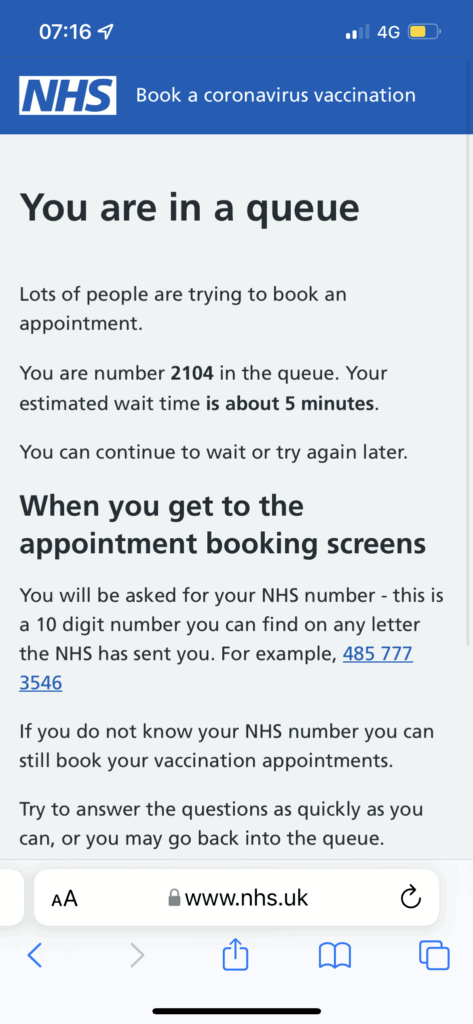
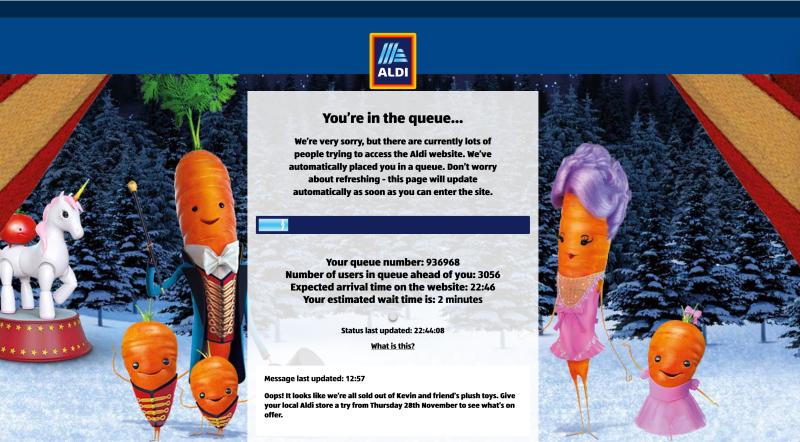
They’ve become a very common site, with Aldi and even the NHS making use of them to manage high demand periods.

aldi virtual queue

nhs virtual queue

The Potential Downsides Of Using A Virtual Queuing System

While the benefits of this type of solutions are undeniable, it’s important to recognise that nothing in web development is a magic fix. As with any platform, there are potential downsides to consider for both your website and your users.

Most importantly, you are still making your users wait. That waiting period is undeniably more pleasant than a crashed website that leaves them wondering what’s going on. Especially around deadlines and in regular shopping windows, users can easily lose patience and decide to try their luck elsewhere. 

Beyond that, a queuing system is another external process to manage and keep up. Both in terms of branding and in the backend. If you’re not careful, or the system is not implemented correctly, the waiting room page could disrupt user experience and cause confusion or a loss in credibility instead of its intended effect.

And of course, queuing system can be implemented to be too sensitive, sending users to a queue despite the fact that the website is actually running as intended and not overloaded. That, in turn, could result in potentially significant lost revenue.

Alternatives To A Virtual Waiting Room

Of course you can up your server capacity enough to handle even drastic spikes in traffic. However, it can be expensive, and can still lead to extreme cases in which even the heightened capacity is reached. We’ve seen it happen to huge organisations like Sky, The National Lottery, and ASDA.

With unlimited resources in place, a combination of scaled server capacity and virtual queuing solution in place for emergencies works well, but is often too expensive for most businesses to consider.

Summary

In the constant quest for increased website reliability and positive UX, virtual queuing system have become a welcome and often necessary solution. Especially as more and more diverse audiences are flocking online.

By sending users to an “in-between” page when maximum web or app capacity is reached, they allow for a more patient approach to online conversions and can lead to not insignificant revenue saved.

Virtual waiting rooms are not, of course, a holy grail of website management that solves all capacity issues. Appropriate and robust hosting is still an important step, and can work especially well in combination with a queuing system. 

Many businesses (including very large organisations like the NHS) have put queuing systems through their paces during the pandemic. This has certainly shown that they work and can be a very valuable tool for digital critical businesses.

The key, as always, is helping your users have a positive experience. To guide them through to the conversion, even in the face of unexpected traffic spikes or website/app downtime.

We can help you get there. Whether that means scaling your website, adding a queuing system to your WordPress website, or some combination of both.  

A picture of James Coates.

If you’d like to learn more about our WordPress & WooCommerce Support & Maintenance plans, drop us an email or give James a call.

Our plans provide a holistic solution to your website’s performance, reliability and security, and are inclusive of premium tools and services.

button to visit contact page
Share Socially
Richard Ramirez
Richard Ramirez
WordPress Developer
Richard started out in technical support role, but soon discovered a passion for PHP. That passion lead him to WordPress, which in turn lead him to Impact Media.
View Team Profile
See More Articles
Richard Ramirez
Richard Ramirez
WordPress Developer
Richard started out in technical support role, but soon discovered a passion for PHP. That passion lead him to WordPress, which in turn lead him to Impact Media.
See More Articles
View Team Profile
Want more control over
how you manage content in WordPress?
Edit content that was previously restricted and get creative with building pages in WordPress.
Let's Chat
studio@impactmedia.co.uk
020 3355 8747
Impact Media's LinkedIn
Impact Media's Twitter
Impact Media's Facebook
Impact Media's Instagram
Impact Media's Youtube
wordpress.org

About Impact

  • About Impact Media®
  • Meet The Impact Team
  • Why WordPress?
  • Our Web Development Process
  • Careers
  • Awards
  • Partners
  • Giving Back
  • 100K Tree Challenge

WordPress Services

  • WordPress Web Design
  • UX Design
  • WordPress Development
  • WordPress Evolve Retainers
  • WooCommerce Development
  • Multisite WordPress
  • Migrate To WordPress
  • Custom Integrations & Plugins
  • WordPress Consultancy

WordPress Support

  • WordPress Support & Maintenance
  • WordPress Managed Hosting
  • Case Studies
  • Insights
  • Contact Us

Addresses

London Address:

50 Liverpool Street,

London, EC2M 7PY, UK

+44 (0) 20 3355 8747


Registered Address:

Woodland Place, Hurricane Way

Wickford, SS11 8YB, UK

  • Privacy Policy
  • Cookie Policy
Impact Media logo
© Impact Media® 2003 - 2026
Impact Media is a trading name of IMDMS LTD. Company Reg. 05970261
Impact® & Impact Media®
are registered trademarks of IMDMS LTD