logo

WordPress Design Agency

020 3355 8747

Message Us
  • Home
  • About Impact®
    Learn More About Impact Media®
    • Meet The Team
       
    • Why WordPress
       
    • Careers
       
    • Giving Back
       
    • 100K Tree Challenge
       
    James Coates
    Schedule a discovery call with UX Specialist James
    Book A Call
  • WordPress Services
    Learn More About Our Services
    • WordPress Web Design
       
    • UX Design
       
    • WordPress Development
       
    • WordPress Support & Maintenance
       
    • WordPress Evolve Retainer
       
    • WordPress Multisite Development
       
    • WooCommerce
       
    • Replatform To WordPress
       
    • WordPress Consultancy
       
    • Integrations & Plugins
       
    • WordPress Managed Hosting
       
    • WordPress Health Check
       
    James Coates
    Schedule a discovery call with UX Specialist James
    Book A Call
  • Our Process
  • Case Studies
  • Insights
  • Contact Us
WordPress Design Agency
020 3355 8747
logo logo
Book A Call
Back
Menu
  • Home
     
  •  
    About Impact Media
    Learn More About The Impacters
    • Meet The Team
       
    • Why WordPress
       
    • Careers
       
    • Giving Back
       
    • 100K Tree Challenge
       
  •  
    Our Services
    Discover How We Can Help
    • WordPress Web Design
       
    • UX Design
       
    • WordPress Development
       
    • WordPress Support & Maintenance
       
    • WordPress Evolve Retainer
       
    • WordPress Multisite Development
       
    • WooCommerce
       
    • Replatform To WordPress
       
    • WordPress Consultancy
       
    • Integrations & Plugins
       
    • WordPress Managed Hosting
       
    • WordPress Health Check
       
  • Our Process
     
  • Case Studies
     
  • Insights
     
  • Contact Us
     
020 3355 8747
Mon - Fri • 9am - 5pm
Close

Oops! We could not locate your form.

Home / Insights / Why Your Website Updates Can’t All Happen at Once
Back

Why Your Website Updates Can’t All Happen at Once

Published 22.10.25
22nd October 2025
Last Updated 28.10.25
28th October 2025
Newer
12 Min Read
Martin Coates
Martin Coates
Support & Maintenance
Older
12 Min Read
 
Martin Coates
Martin Coates
 
Support & Maintenance

If you’ve ever wondered why your web devs don’t push multiple updates to your website at once, this is the post for you.

Does the following sound at all familiar?

You report a website bug to your web developers on Monday morning, perhaps the contact form isn’t sending enquiries to the right email address?

By Tuesday afternoon, it’s resolved and working perfectly.

Encouraged by this swift resolution, you send through two more requests to your devs. Let’s say, you want to add a new landing page for your upcoming campaign, and you want to have the entire product catalogue rebuilt with new filtering.

A week later, the landing page still isn’t live. Frustrated, you wonder “why can’t they work on everything at once?”

The answer lies in how modern web development actually works, and why the systems developers use (like version control and development queues) exist to protect your website and your business.

Understanding these processes won’t just reduce your frustration, it’ll help you plan better campaigns and set realistic expectations with stakeholders.

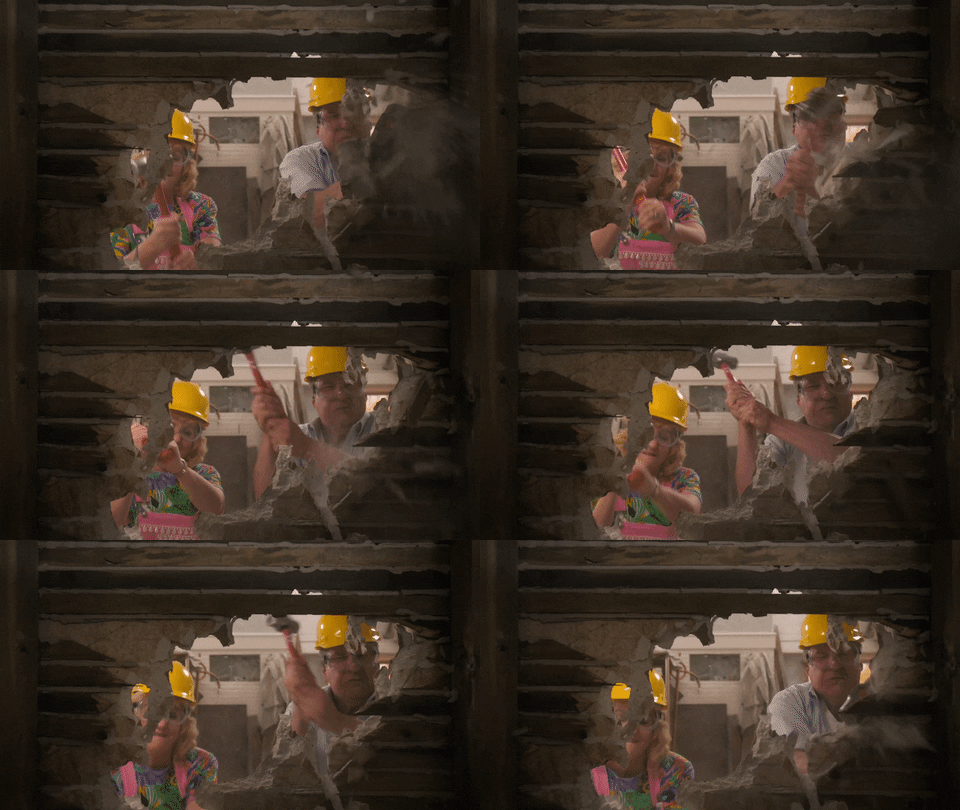
The Kitchen Refit You Can’t Walk Away From

Imagine hiring a builder to renovate and fit your kitchen. You wouldn’t just hand them the keys, disappear for a couple of months, and expect perfection when you return.

You’d check in regularly, making sure they are following your carefully planned out design, approve any outstanding design choices (the round or the square door handles), and make decisions when unexpected issues arise (like the height of power sockets, or the discovery of dodgy wiring or pipework). You also wouldn’t add “oh, and whilst you are doing the pipework, you might as well do the bathroom too” halfway through, without expecting delays or budget changes.

Your website works the same way. Unlike a kitchen refurb where you can avoid the construction area, your website serves customers 24/7. Every change must be carefully tested before it goes live, because there’s no “closed for refurb” sign you can hang on the internet (don’t even think about adding an under construction page!)

This is why web developers use something called a development queue. An organised system for managing what gets built, when, and how.

Just like an A&E doesn’t treat patients in the order they arrive, but instead uses a triage system (a broken arm waits while a heart attack gets immediate attention), development work gets prioritised based on impact, complexity, and urgency.

Your Website Has A Testing Pipeline (That’s A Good Thing!)

Before any change reaches your live website, it travels through multiple environments designed to catch problems before your customers see them. Think of it as a quality control assembly line.

The Development (or Local) Environment

This is where developers write code and do initial testing. This is essentially their workshop – messy, experimental, and not ready for anyone else to see.

The Staging Environment

This is a replica of your live site, where everything gets final testing. It’s like a dress rehearsal before opening night.

Does the new landing page work on mobile? Does it load quickly? Do all the forms still work after adding that new feature? Staging answers these questions.

The Production Environment

This is your live website. Only code that’s passed all previous tests makes it here.

This pipeline is why “just one small change” can take a few days. That bug fix on your contact form might seem instant to you, but we test it on staging first to make sure fixing the email routing didn’t accidentally break the form validation, or affect other shared components.

Staging environments reduce production errors by catching issues before real customers encounter them, leading to higher uptime and customer satisfaction.

Version Control Is Like Google Docs For Your Entire Website

Remember the chaos of document filenames like ‘Marketing_Plan_FINAL_v3_ACTUALLY_FINAL.docx’? Version control systems like Bitbucket, GitHub and GitLab I promise I’m not swearing at you) solve this problem for websites.

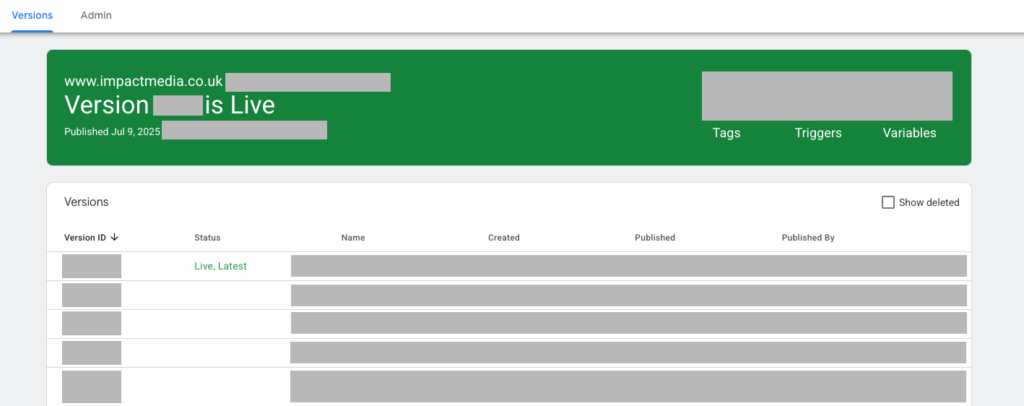
Think of version control like Google Docs’ version history, but with superpowers. Every change to your website is saved as a ‘commit’, which is a snapshot with a description of what changed and who changed it. If you use Google’s Tag Manager, you’ll be familiar with its similar, although far simpler, version control system.

If something breaks, developers can see exactly what changed, when, and roll back to a working version. Nothing is ever truly deleted.

Here’s where it gets interesting for managing multiple projects. Version control uses branches. These are parallel versions of your website where our developers can work on different features simultaneously, without interfering with each other.

Picture a tree trunk (your live website) with branches shooting off. One developer creates a ‘new-landing-page’ branch to build your campaign landing page. Another creates a ‘product-catalogue-rebuild’ branch for the product filtering. Each branch is isolated. The landing page developer can experiment freely without worrying about breaking the catalogue work in progress.

Why Branches Can’t All Merge At Once

This is where many clients get frustrated. If developers can work on separate branches, why can’t everything go live simultaneously?

The reality is that code isn’t like assembling furniture. When you build a bookshelf and a desk separately, you can use both immediately. When you build two website features separately, they might modify the same underlying code, use shared resources, or create conflicts when combined.

Version control calls these merge conflicts. Situations where two people changed the same thing in different ways, and the system needs human judgment to decide which version to keep. It’s like two editors making contradicting suggestions for the same paragraph. Someone needs to review both changes and make a call.

But conflicts aren’t the only challenge. Even when features don’t directly conflict, they need testing together before going live.

Your new landing page might work perfectly in its branch. Your product catalogue rebuild might work perfectly in its branch. But when both features are on the live site simultaneously, they might compete for resources, slow down page load times, or create unexpected interactions.

The Airport Runway Principle

Testing environments face the same constraint as airport runways. Only one plane can land at a time. Your staging environment can only test one version of your website at once.

For example, when your web development team is juggling that campaign landing page you need, the major product catalogue rebuild, and a bug fix, they can’t test all three simultaneously on staging.

The catalogue rebuild might take two weeks to fully test, trying different filters, checking mobile responsiveness, verifying database performance, testing on different browsers, etc. During those two weeks, the landing page sits waiting, like a plane waiting to taxi.

This is why larger projects create queues. The substantial product catalogue rebuild blocks other work. Not because developers are slow, but because thorough testing takes time and can’t be rushed without risking errors that affect your customers and business.

When Urgency Interrupts The Queue

Here’s where development gets really interesting! What happens when something urgent comes up whilst developers are deep in that catalogue rebuild?

Our team uses priority frameworks to triage work. Think of it like the triage process used by the A&E Department of your local hospital:

P1 – Critical – Your website is completely down, checkout is broken, or there’s a security breach. Everything stops, and it’s all hands on deck. This gets fixed within hours.

P2 – Important – A major feature is broken for a significant portion of users. We address this within a day or two, potentially pausing feature work.

P3 – Minor – Cosmetic issues, small improvements, or edge cases. These wait until higher priorities are handled.

Our team also works on rotas, with some focusing on projects and tasks, and others being available solely for support. Having dedicated members of the team who are ‘on call’ in the triage room waiting to diagnose issues. This frees up other team members who are focused on the planned development without being interrupted when an urgent ticket is raised.

The Hotfix Jumps The Queue (Carefully!)

When a critical bug hits, for example, your checkout suddenly breaks on Black Friday, or your landing page form breaks as you launch a big new campaign, we use a special process called a hotfix. Think of it as the hard shoulder on the motorway, only to be used for breakdowns or emergencies.

We create a hotfix branch directly from your live site (not from ongoing feature work), fix the critical issue, test it thoroughly but quickly, and deploy it to production. Then, and this is crucial, we merge that fix back into all the ongoing feature branches, so the bug doesn’t reappear when new features launch.

Hotfixes are expensive. They interrupt focused work, require context switching, and often introduce minor delays to planned features. This is why clear prioritisation matters. Not everything that feels urgent truly warrants jumping the queue.

Managing Expectations – What You Can Control

Understanding these technical realities helps you make smarter decisions:

Plan Feature Requests Strategically

If you need a landing page for a campaign launching in three weeks, discuss it early. If we’re mid-way through a complex project, we can help you decide whether the campaign should wait, or if the other work should be deprioritised.

Accept That Adding Features Mid-Project Has Costs

When you request “just one more thing” during active development, you’re choosing between three options:

  1. Extend the timeline.
  2. Increase the budget.
  3. Remove something else from scope.

None of these are punishments. They’re the mathematical reality of fixed resources.

Communicate Urgency Clearly And Honestly

When everything is marked urgent, nothing is. Save “urgent” for genuine business impact. That typo on your About page probably isn’t stopping sales and it can wait until after the critical catalogue launch.

Trust The Testing Process

Staging environments and sequential deployment exist. because rushing changes to production creates expensive problems. The few extra days of testing prevent the much longer delays of fixing bugs in production.

Where possible, we use the Impact team approach, bringing in specialists for specific challenges rather than having one developer juggle everything.

This means your catalogue rebuild might have a backend specialist handling database optimisation, whilst a frontend developer works on the user interface. This parallel work within a single project speeds things up without compromising quality or creating conflicts.

The Development Queue Protects Your Investment

Development queues and version control might seem like bureaucratic obstacles or process gone wild, but they’re actually protecting your business. They ensure that:

  • Nothing breaks invisibly – every change is tracked and can be undone if needed.
  • Multiple people can collaborate – without overwriting each other’s work.
  • Quality stays high – because testing can’t be shortcut.
  • Emergency fixes happen fast – without contaminating ongoing work.
  • You maintain a clear history – of what changed, when, and why.

Think of it this way. You could have someone add some vibe-coded feature directly to your live site with no testing, no version control, and no queue. Changes would happen instantly. But you could also experience outages, mysterious bugs that take days to diagnose, code-compatibility issues, lost work when things break, and no way to undo problematic changes. The queue exists because the alternative is chaos.

Working With The Queue, Not Against It

The best client relationships happen when both sides understand the constraints and plan accordingly:

Have regular check-ins – (monthly at minimum) where you discuss upcoming needs and current progress. This helps us plan capacity and helps you adjust expectations before missing critical deadlines.

Bundle related changes – when possible. If you need several small updates to the same page, request them together so we can test everything in one staging cycle.

Distinguish between ‘must-have‘ and ‘nice-to-have’ – When we ask you to prioritise, we’re not being difficult. We’re helping you make strategic decisions about where to invest limited development time.

Expect transparency, not perfection – We’ll tell you when we encounter unexpected complexity, when timelines need adjustment, or when your request conflicts with other priorities. These aren’t excuses, they’re professional honesty that prevents bigger problems later.

The Bottom Line

Your website isn’t a document where you can make unlimited tracked changes simultaneously. It’s a complex system where changes can interact in unexpected ways, where testing takes time, and where rushing creates expensive problems.

Development queues and version control exist for the same reason hospitals have triage systems and air traffic control manages runway access. They bring order to complexity, prevent catastrophic errors, and ensure that urgent needs get addressed without sacrificing quality on routine work.

The next time you submit three requests and wonder why they can’t all be completed and pushed immediately, remember, they can all be worked on simultaneously in separate branches, but they must be tested and deployed sequentially.

The queue isn’t slowing you down, it’s ensuring that when changes do go live, they work correctly and don’t break everything else you’ve built.

Understanding this won’t make development faster, but it will make planning easier, reduce frustration, and help you have more productive conversations with your web development partner. Sometimes, that’s even more valuable than speed.

A picture of James Coates.

If you’d like to learn more about our WordPress & WooCommerce Support & Maintenance plans, drop us an email or give James a call.

Our plans provide a holistic solution to your website’s performance, reliability and security, and are inclusive of premium tools and services.

button to visit contact page

Share Socially
Martin Coates
Martin Coates
Technical Director, Golf Enthusiast & Ex-Superstar DJ
Martin is Mr Technical. His background is in PHP & WordPress development, however, the thing that keeps him up at night now is how to make websites load faster. Insights on performance optimisation and security are what you'll mostly find Martin sharing.
View Team Profile
See More Articles
Martin Coates
Martin Coates
Technical Director, Golf Enthusiast & Ex-Superstar DJ
Martin is Mr Technical. His background is in PHP & WordPress development, however, the thing that keeps him up at night now is how to make websites load faster. Insights on performance optimisation and security are what you'll mostly find Martin sharing.
See More Articles
View Team Profile
Looking For Support For
Your WordPress Website?
Let Us Take The Stress Of Website Maintenance & Support Off Your Plate
Let's Chat
studio@impactmedia.co.uk
020 3355 8747
Impact Media's LinkedIn
Impact Media's Twitter
Impact Media's Facebook
Impact Media's Instagram
Impact Media's Youtube
wordpress.org

About Impact

  • About Impact Media®
  • Meet The Impact Team
  • Why WordPress?
  • Our Web Development Process
  • Careers
  • Awards
  • Partners
  • Giving Back
  • 100K Tree Challenge

WordPress Services

  • WordPress Web Design
  • UX Design
  • WordPress Development
  • WordPress Evolve Retainers
  • WooCommerce Development
  • Multisite WordPress
  • Migrate To WordPress
  • Custom Integrations & Plugins
  • WordPress Consultancy

WordPress Support

  • WordPress Support & Maintenance
  • WordPress Managed Hosting
  • Case Studies
  • Insights
  • Contact Us

Addresses

London Address:

50 Liverpool Street,

London, EC2M 7PY, UK

+44 (0) 20 3355 8747


Registered Address:

Woodland Place, Hurricane Way

Wickford, SS11 8YB, UK

  • Privacy Policy
  • Cookie Policy
Impact Media logo
© Impact Media® 2003 - 2025
Impact Media is a trading name of IMDMS LTD. Company Reg. 05970261
Impact® & Impact Media®
are registered trademarks of IMDMS LTD